| Email:Mannan.Ali@physics.org | Chapter 7: Conclusions and Future work |
|---|---|
| Web: http://members.xoom.com/MannansZone/thesis.html |
7.0 Conclusions and Future work
In this thesis it has been demonstrated by the experimental results and discussions that FeSiBC films, deposited by RF magnetron sputtering can be produced with excellent soft magnetic properties; which are comparable with those exhibited by the METGLAS® 2605SC ribbon material from which the films were sputtered. The three main requirements for device quality films were satisfied: the correct composition was attained by sputtering from the correct compositional target, the microstructure was amorphous, and it has been shown that the magnetic anisotropy of the films is controllable. A summary of the main conclusions from the respective chapters is given below.
A MOKE magnetometer and a domain imaging system were constructed by the author in order to characterise the magnetic thin films utilising the Magneto Optical Kerr effect. The general principles of the Kerr effect have been discussed with a view to providing an insight into the implementation of the Kerr effect, and the interpretation of the domain images which are obtained using this effect. The two systems were used to investigate the in-plane anisotropy in the deposited amorphous FeSiBC films. The magnetometer was also used to interrogate the changes in the magnetic properties of a micro-machined membrane-type pressure sensor; this had been designed by Karl et al (1999 [2.8]).
Comparisons of hysteresis loops with measurements made at York University and with bulk hysteresis loops have shown that the results can be taken to be reliable.
MOKE was also utilised in a novel simple method of measuring the saturation magnetostriction of the FeSiBC films.
It has been shown that the deposition of films by sputtering is a complex process which is strongly dependent on many parameters. In this investigation, the sputtering process was mainly optimised by careful control of the sputtering pressure, since the sputtering power was chosen to give a reasonable deposition rate of approximately 5.5nm/min, and also to ensure that the temperature of the substrate was below 600C. This avoided stresses being induced due to the different thermal expansion coefficients of the film and substrate. It was found that the use of a low sputtering power ensured that the sputtering kinetics could be moderated at low argon pressures. Higher sputtering powers would have increased the deposition rates, but this would have meant that higher pressures would have been required to moderate the sputtering process, and this would have increased any possible argon incorporation into the films. It has been demonstrated that, once the sputtering conditions have been carefully optimised (75W, 4mTorr), it is possible to deposit amorphous FeSiBC films by RF magnetron sputtering, which have excellent soft magnetic properties in the as-deposited state. Films have been deposited onto commercially important substrates such as GaAs, Si and Si3N4, which are compatible with the microelectronic fabrication technologies. This allows the fabrication of both the magnetic sensor and the electronic detection system on a single substrate, making it commercially more attractive. It also eliminates the problem of physically bonding the magnetostrictive material to the device.
| Growth and study of magnetostrictive FeSiBC thin films, for device applications, Mannan Ali (1999) | 170 | |
|---|---|---|
| (Online Copy) |


| Email:Mannan.Ali@physics.org | Chapter 7: Conclusions and Future work |
|---|---|
| Web: http://members.xoom.com/MannansZone/thesis.html |
Stress due to the sputtering process has been identified as the major factor in controlling the magnetic softness of the deposited films. Any factors which influence the sputtering dynamics will therefore have a direct effect on the stress induced in the films. At the sputtering conditions investigated (75W, 4mTorr) it appeared that the films were insensitive to oxygen contamination, but very sensitive to oil-based contaminants from the cleaning procedure and the diffusion pump. This contamination induced a state of compressive stress in the films, and it was also inferred that it altered the magnetic properties, since it was found that annealing did not produce the soft magnetic properties which were expected.
At the optimised sputtering parameters of 75W and 4mTorr, the as-deposited films had typical coercivities of 20-30 A/m; this was further reduced to ~10 A/m on annealing, which compares well with the values of 10 A/m for the annealed ribbons. The size of the anisotropy field of the as-deposited films at these parameters is highly dependent on the substrate position because of the radially induced anisotropy which is produced by the residual field from the magnetron source.
It has been shown that the as-deposited films display a significant, reproducible in-plane anisotropy, which is radial about a central point which corresponds to the centre of the magnetron sputtering source. This radial anisotropy has been shown to be a consequence of the small in-plane residual field present at the substrate platter. Its linear and symmetrical form could be utilised in the production of samples where a range of anisotropy fields and directions are needed.
The control of magnetic anisotropy in FeSiBC films by various treatments has been described. Field annealing is shown to be capable of producing a small transverse anisotropy. The use of stress induced anisotropy, either during the growth or subsequent annealing, has been shown to give rise to a well defined, strong anisotropy whose magnitude can be easily controlled by varying the applied stress.
A new, simple technique for the measurement of magnetostriction in thin films deposited onto fairly rigid thick substrates has been described. It has been applied to amorphous FeSiBC films sputter deposited onto microscope slides, Corningâ glass and silicon substrates. For these systems, the error in the measurement of magnetostriction is determined almost entirely by the uncertainty in the Young’s modulus. The technique has also been applied to an FeCo film deposited by sputtering onto a microscope slide. For both FeSiBC and FeCo, the values obtained are in good agreement with expected values.
The technique can be applied to a wide variety of different film/substrate combinations. If the Young’s modulus of the film is known to a high accuracy, then the error in the value of ls obtained can be less than 5%, which compares well with other techniques. Such precise, quantitative values could be used to provide sample standards for use with other methods. The technique is not limited by film thickness, since the Magneto-Optical Kerr Effect can comfortably monitor the magnetisation down to a film thickness of 10nm. It overcomes the problem of non-uniform stresses by correlating the local stress with that of the local anisotropy field. No mechanical properties of the substrate are required, simplifying the calculation of ls. The equipment needed to implement the technique is inexpensive and commonly available; no special preparation of samples are required. This method gives a useful alternative to the conventional techniques and can be applied to films deposited onto moderately thick substrates. This
| Growth and study of magnetostrictive FeSiBC thin films, for device applications, Mannan Ali (1999) | 171 | |
|---|---|---|
| (Online Copy) |
| Email:Mannan.Ali@physics.org | Chapter 7: Conclusions and Future work |
|---|---|
| Web: http://members.xoom.com/MannansZone/thesis.html |
magnetostriction measurement may be applicable to films deposited onto a wide variety of commercially important substrates, for which there may be no alternative techniques.
Since magnetostriction is a fundamental physical property of magnetic materials, it is vital for high precision devices (such as magnetic information storage systems) that accurate quantification of its effects can be obtained.
The values of magnetostriction obtained in this study have been very reproducible from the three different methods used to strain the magnetic films. It has been found that the substrates have no significant influence on ls, and the magnetic softness (coercive fields), which is presumed to be caused by residual strains, also has little influence. These experiments also show that, in these strongly magnetostrictive materials, ls is independent of strain for the applied strains and also the residual strains caused by the substrate.
The technique of stress annealing to tailor the anisotropy field has been demonstrated to a high degree of precision on silicon and Corningâ glass substrates. It provides an excellent means of inducing a given anisotropy field in thin film sensors. It also provides the means of inducing a well defined uniaxial domain structure, which simplifies the understanding of the magnetisation process for device applications.
Photolithographically patterned films display no adverse effects from the process, and it has been shown that the process of field annealing is still able to induce a weak uniaxial anisotropy in films with reduced lateral dimensions which is important for sensor devices.
Preliminary investigations into the MI effect in magnetostrictive (FeSiBC) and non-magnetostrictive (CoFeB) thin films have shown that MI ratios of 1% are attainable at relatively low frequencies (5-7MHz). It has been demonstrated that the MI response is correlated to the domain structure and the magnetisation process.
For the ribbon samples investigated, it appears that the MI response below 1MHz is due to domain wall movement (oscillations), whereas above 1MHz as with the deposited films, it is due to the oscillation of the domain magnetisation (domain rotation). A simplified rotational model was used to illustrate that the MI curves obtained by experiment, were due to the process of domain rotation.
MI measurements carried out on the layered FeSiBC thin films were inconclusive and it likely that these preliminary investigations were impaired by the diffusion of the copper into the magnetic layers.
It is believed that on further work, the problem of copper diffusion can be eliminated by the use of silver as the conductive core and thus be possible to reproduce similar results to those obtained by Morikawa et al (1997 [6.8]) on layered films. This increase in the MI ratio without an increase in the operating frequency would be more attractive in development of thin film sensors based on the MI effect. It has been discussed in chapter 5, that in the FeSiBC films the stress induced anisotropy scales linearly with stress, as ascertained by MOKE. A similar principle could also be applied using the MI effect to measure the variation of the stress induced anisotropy as function of stress and could therefore form a basis of stress sensor.
| Growth and study of magnetostrictive FeSiBC thin films, for device applications, Mannan Ali (1999) | 172 | |
|---|---|---|
| (Online Copy) |
| Email:Mannan.Ali@physics.org | Chapter 7: Conclusions and Future work |
|---|---|
| Web: http://members.xoom.com/MannansZone/thesis.html |
It has been demonstrated successfully that soft amorphous FeSiBC films can be attained by very careful optimisation of the sputtering parameters. The basic magnetic properties have been characterised, along with the as-deposited radially induced anisotropy. Typical values for the coercive fields for the as-deposited films were 20-30 A/m. However, at times, the as-deposited films exhibited easy axes coercive fields, as low as 2 A/m as shown in Figure 7.1. These were only obtainable for the first one or two depositions, immediately after the sputtering machine was thoroughly cleaned (external shot blasting). It was assumed that the sputtering environment was being minutely contaminated by oil vapour from the diffusion pump which therefore gave rise to a slight increase in the coercive fields to 20-30 A/m. It is, therefore, likely that improvements in the cleanness of the sputtering environment will allow the deposition of FeSiBC films with coercive fields in as-deposited state which are comparable or better than its ribbon counter part.
An absolute value of the saturation magnetisation was not ascertained during the study, nor was the exact composition of the as-deposited films. It is believed, however, that values are similar to those of the METGLAS® 2605SC ribbon, since the composition has an influence on the value of the saturation magnetostriction which was measured to be similar to that of the ribbon material. Further work on the effects of temperature on these FeSiBC films would be the obvious path to follow, especially if these types of highly magnetostrictive materials are intended to be utilised in micro-machined magnetic devices. Increases in temperature will be more significant in systems where the thermal expansion coefficients of the deposited film and substrate are different. This will introduce stress into the magnetic film and will obviously effect the magnetic properties of the film.
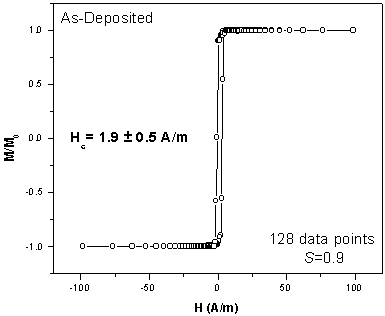
Figure 7.1: Easy axis MOKE loop from an as-deposited FeSiBC film obtained in a very clean environment. (75W,4mTorr).
| Growth and study of magnetostrictive FeSiBC thin films, for device applications, Mannan Ali (1999) | 173 | |
|---|---|---|
| (Online Copy) |