Email:Mannan.Ali@physics.org Chapter 6: Magneto Impedance investigation
Web: http://members.xoom.com/MannansZone/thesis.html


6.0 Magneto Impedance investigation

6.1 Introduction

In recent years there has been a considerable upsurge of interest in the Magneto Impedance (MI) effect, found in soft, amorphous, ferromagnetic materials. The MI effect consists of large changes in the high frequency impedance Z, found in nearly zero magnetostrictive Fe/Co based alloys in the form of melt-spun wires and ribbons. The majority of the research performed has been focused on soft amorphous cobalt based alloys, in the form of wires and ribbons, even though the effect can be observed in a wide variety of materials, as the MI effect has been found to have the largest values in these materials. The intensive research into the MI effect is a result of its technological importance in the field of sensor applications [Vazquez et al (1996)]. A number of authors have shown the effect to have great potential for magnetic sensor applications [Panina et al (1994), Mohri et al (1995), Atkinson et al (1998)]. MI effects have been found to be more field sensitive than the well established giant magneto-resistance (GMR) effects found in GMR materials. These latter materials generally require large fields to obtain a GMR response of a few percent, whereas the MI materials can produce responses of a few hundreds of a percent in very small fields of the order likely to be encountered in practice. It has also been reported [Sinnecker et al (1998)] that under certain conditions the MI effect does not exhibit hysteresis effects, as is the case with GMR materials; hysteresis is undesirable for sensor applications.

The drive for magnetic sensors to become miniaturised has now increased with fresh technological demands. In these systems, sensors are now being incorporated onto commercially important substrate materials such as silicon and gallium arsenide. The advantage of this arrangement is that the sensor, and its electrical detection/analysing circuitry, can be fabricated on the same substrate. In order to make such sensor devices, it is necessary to deposit the magnetic material in the form of a thin film. It would be difficult to incorporate existing favourable MI materials into such devices in their current form of ribbons or wires. Here a different approach to the MI effect is undertaken. Magnetic amorphous films and multi-layered films produced by sputter deposition have been investigated for their potential use as MI materials in sensors. There has been only limited research done on the MI effect in thin films in comparison to their bulk counterparts [Morikawa et al (1995), Panina et al (1995)]. Mokirawa and co-workers have shown, by using multi-layered films, that it is possible to increase the MI effect in thin films compared to single layered films, thereby increasing their usefulness as sensor materials. The objective of this preliminary study into the MI effect, is to ascertain the potential use of FeSiBC films for MI sensors, and to correlate the magnetic properties with the impedance responses.

Part of this work was supported by the British Council and the Spanish Ministerio de Education y Ciencia under the Acciones Integradas program (HB95-0013).


Growth and study of magnetostrictive FeSiBC thin films, for device applications, Mannan Ali (1999) 130
(Online Copy)


 Link bar
 Link bar

Email:Mannan.Ali@physics.org Chapter 6: Magneto Impedance investigation
Web: http://members.xoom.com/MannansZone/thesis.html


6.2 Magneto Impedance

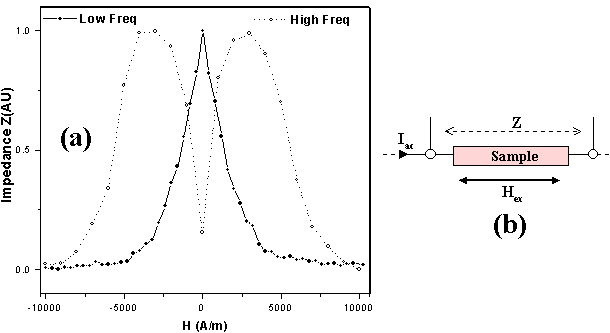
When a magnetic material carrying a low intensity, high frequency (up to 100MHz) alternating current is subjected to an external magnetic field, it exhibits a sharp change in its electrical impedance as shown in Figure 6.1a. This effect is known as the magneto impedance (MI) or the giant magneto impedance (GMI) effect. The external magnetic field is generally applied along the direction of the current flow as shown Figure 6.1b. The two MI curves shown in Figure 6.1a have been labelled as having been obtained at a low and high frequency. It can be seen from these two curves that the frequency of the applied current also has an effect on the form of the MI curve. The changes in the impedance are a consequence of changes in the interaction between the magnetisation of the material and the alternating magnetic field generated by the current. These changes occur due to the externally applied magnetic field. The key to understanding the MI effect is the effective permeability (meff) or effective susceptibility (ceff) [meff=ceff + 1] of the magnetic material. The magnetic field dependence of the impedance is controlled by the ability of the magnetisation to respond to the magnetic field generated by the current. This is governed by the effective susceptibility of the material in the direction of the field produced by the current. The application of the external field simply alters this effective susceptibility, which leads to the changes in the impedance. The impedance maxima shown in Figure 6.1a correspond to a maximum in the effective susceptibility. For the impedance curve obtained at low frequency, the effective susceptibility is a maximum when no external field exists, but decreases on the application of a field. This is not the case for the curve obtained at the higher frequency. Here the effective susceptibility increases to a maximum on the application of a small applied field, before decreasing with further increases of the field. The effective susceptibility is, in each case, influenced by two different magnetisation processes. The effective susceptibility in the low frequency case is dominated by reversible domain wall movement , whereas in the high frequency case, it is dominated by
Typical MI curves

Figure 6.1: (a) Typical MI curves obtained from a FeSiBC film at two different current frequencies (labelled as low and high) as a function of applied magnetic field. Note the two curves have been normalised. (b) Illustration of basic impedance measurement.


Growth and study of magnetostrictive FeSiBC thin films, for device applications, Mannan Ali (1999) 131
(Online Copy)


 Link bar
 Link bar

Email:Mannan.Ali@physics.org Chapter 6: Magneto Impedance investigation
Web: http://members.xoom.com/MannansZone/thesis.html


domain rotation (rotation of the magnetisation). For the high frequency MI curve, the two maxima can correspond to the anisotropy field of the sample obtained along the length of the sample. At sufficiently high frequencies, the skin effect (see below) can dramatically effect the impedance of the material, which is also dependent on the effective susceptibility. It is therefore possible to separate the MI effect at high and low frequencies.

It is generally accepted that when one refers to the giant magneto impedance (GMI) effect, it usually means that a skin effect is present which gives rise to much larger impedance changes. Whereas at low frequencies, where the influence of the skin depth is weak or non-existent, it is termed the MI effect, or more correctly the magneto inductive effect.

6.2.1 Low frequency limit

At relatively low frequencies, where the influence of the skin effect is negligible, the MI effect is due to changes in the reactance. In this situation the alternating current generates a magnetic driving field, which causes domain wall movement (oscillation), which in turn dominates the effective susceptibility. The changing magnetisation induces an additional voltage contribution, VL, which adds to the ohmic voltage due to the current [Mohri et al (1992), Velazquez et al (1994)].

Eq. (6.1)(6.1)

This additional induced voltage is termed the magneto-inductive voltage. The larger the effective susceptibility, the larger will be the change in the magneto-inductive voltage. On application of an external magnetic field, the changing magnetisation due to domain wall movement is suppressed and the magnetisation is rotated towards the applied field. This has the effect of decreasing the effective susceptibility, since the component of magnetisation which can interact with the alternating magnetic field generated by the current has been reduced. This leads to a fall in the magneto-inductive voltage, giving rise to the magnetic dependence of the impedance. This type of MI effect is relatively small compared to the GMI effect; the largest effect is found in cobalt based amorphous wires [Mohri et al (1992)].


Growth and study of magnetostrictive FeSiBC thin films, for device applications, Mannan Ali (1999) 132
(Online Copy)


 Link bar
 Link bar

Email:Mannan.Ali@physics.org Chapter 6: Magneto Impedance investigation
Web: http://members.xoom.com/MannansZone/thesis.html


6.2.2 High Frequency limit (<100MHz)

The GMI effect has been explained in terms of classical electrodynamics [Beach et al (1994), Panina et al (1994)] as an interaction between the magnetic field created by the current and the magnetisation. At high frequencies the GMI effect is mainly due to changes in the resistive component of the impedance, since it is dominated by the skin effect. This causes the current to flow near the surface of the material, reducing the effective cross-sectional area of the material, leading to an increase in the resistive component of the impedance.

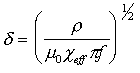
A mathematical description of the skin effect has been obtained from classical electrodynamics. For a conductor carrying a sinusoidal alternating current, the penetration or skin depth, d, is given by the well known expression
Eq. (6.2)(6.2)

where f is the frequency of the current, r is the resistively of the material, and ceff is the susceptibility. The susceptibility is the effective susceptibility in the case of GMI effect. It has been shown that for a thin film the impedance Z is related to the skin depth through the following expression [Panina et al (1995)]
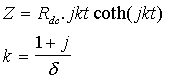
Eq. (6.3)(6.3)

where Rdc is the dc resistance, and t the thickness of the conductor. It follows from expressions (6.2) and (6.3), that the impedance of a magnetic conductor again is dependent upon the effective susceptibility, through the skin depth. Here the effective susceptibility arises from two contributions: domain wall movement and oscillation of the domain magnetisation. At low frequencies, the domain wall movement dominates the susceptibility, whereas at higher frequencies the domain wall movement is strongly damped by microscopic eddy currents [Panina et al (1996)], and the magnetisation rotation contribution becomes dominant. Generally, this process results in a complex effective susceptibility [Panina et al (1996)]. The damping of the domain wall movement at high frequencies reduces the hysteresis effect, which is generally the source of the magnetic hysteresis. For successful sensor applications, it is vital that no hysteresis is present and therefore magnetisation rotation is usually preferable.


Growth and study of magnetostrictive FeSiBC thin films, for device applications, Mannan Ali (1999) 133
(Online Copy)


 Link bar
 Link bar

Email:Mannan.Ali@physics.org Chapter 6: Magneto Impedance investigation
Web: http://members.xoom.com/MannansZone/thesis.html


6.3 Domain structure and magnetostriction

From the description of the MI effect so far, it is clear that the effect is controlled by the effective susceptibility. The magnitude of the susceptibility is controlled by the magnetic anisotropy of the material. For amorphous materials the intrinsic magnetic anisotropy is usually very small, and generally the magnetic anisotropy is extrinsically induced. This could be due to structural defects, strains/stresses introduced during the production of the material, or that of post production heat treatments, such as magnetic field annealing. Typically, the magnetic anisotropy for melt spun ribbons and wires is dominated by the stresses induced by the melt-spinning process. This is usually also the case with sputter deposited magnetic thin films, but not always, as shown by the radially induced magnetic anisotropy in the FeSiBC films discussed in Chapter 5, where it is inferred that the stresses induced during the deposition were negligible. It has been shown in Chapter 5, that the magnetic anisotropy, and therefore the domain structure, can be extrinsically controlled by various heat treatments. To obtain a significant MI effect, it has been generally found by many authors that the material should possess a domain structure in which the domain walls are perpendicular to the current direction. This ensures that the oscillating field generated by the current lies in an easy axis for the magnetisation. This should therefore maximise the effective susceptibility of the system.

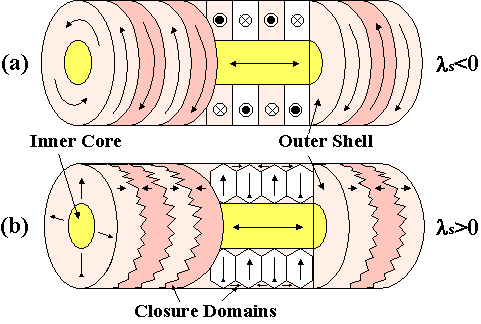
There have been numerous investigations [Panina et al (1996), Tejedor et al (1996), Rao et al (1994)] of how the domain structure influences the MI effect. The nature of the magnetic anisotropy has been found to be especially critical in the case of amorphous wires [Costa-Kramer et al (1995), Panina et al (1996)]. Depending upon the sign of the magnetostriction, the amorphous wires which are produced by ejecting the melt into a continuous flow of rotating water, solidifies rapidly developing mainly a tensile radial stress distribution. This leads to two different domain structures being induced in the wire (Fig. 6.2). It is now generally accepted that the domain structures which result for the as-cast wires are
Domain structure of amorphous melt-spun wires

Figure 6.2: A simplified illustration of the domain structure for (a) negative magnetostriction, and (b) positive magnetostriction in amorphous melt-spun wires [Squire et al (1994)] of circular cross-section. The magnetoelastic coupling produces two different magnetic anisotropies, where the circumferential anisotropy (a) is more favourable than the radial (b) anisotropy for the MI effect in a circular wire.


Growth and study of magnetostrictive FeSiBC thin films, for device applications, Mannan Ali (1999) 134
(Online Copy)


 Link bar
 Link bar

Email:Mannan.Ali@physics.org Chapter 6: Magneto Impedance investigation
Web: http://members.xoom.com/MannansZone/thesis.html


associated with the coupling between the magnetostriction and the stresses induced by the rapid quenching process. For both positive and negative magnetostrictive wires, the domain structure consists of essentially two regions as shown in Figure 6.2. The core region for the two wires is a single domain, with the magnetisation running along the length of the wire, and the outer region is a multi-domain structure, where the magnetisation is oriented radially for a positively magnetostrictive wire (moments lie along the stress direction), and circumferentially for a negatively magnetostrictive wire. The magnetic field generated by the alternating current is of a solenoidal form, and one would therefore expect to see a much greater MI effect in the case of the amorphous wires which have a circumferential domain structure (Fig. 6.2a), compared to that of the radial domain structure (Fig. 6.2b). Experimentally this has been found to be the case by many authors, and this partly explains why the Co based amorphous wires show the greatest effect, because the negative magnetostriction induces a favourable magnetoelastic anisotropy. Also the Co based materials have much lower anisotropy constant giving them a larger effective susceptibility. A recent investigation of the MI effect on FeSiB amorphous wires by Takemura et al (1996) has shown that, by lightly annealing the amorphous wires, the radial domain structure (Fig. 6.2b) of the as-cast wire weakens, and gives way to a circumferential domain structure; this is due to surface crystallisation. This leads to an increase in the MI effect, which has also been reported by Atkinson et al (1995), and highlights the importance of the domain structure on the MI effect. It is only the Co based amorphous wires which exhibit nearly zero magnetostriction which show the largest MI effect. Not only does the sign of the magnetostriction control the type of magnetic anisotropy induced, but the magnitude of the magnetostriction also influences how large a coupling there is between the magnetisation and the stresses. Too large a coupling would reduce the effective susceptibility, because of the larger induced magnetoelastic anisotropy. It is generally found that the nearly zero magnetostrictive materials are magnetically much softer (smaller coercive fields < 1A/m) as compared to those materials which have larger magnetostriction values, but the magnetostriction coupling is sufficient to induce a well defined magnetoelastic anisotropy. The same principles also apply to ribbons and thin films, where a uniaxial anisotropy of low magnitude is usually found to produce the maximum MI effect.


Growth and study of magnetostrictive FeSiBC thin films, for device applications, Mannan Ali (1999) 135
(Online Copy)


 Link bar
 Link bar

Email:Mannan.Ali@physics.org Chapter 6: Magneto Impedance investigation
Web: http://members.xoom.com/MannansZone/thesis.html


6.4 Sample preparation

The objective of this preliminary study into the MI effect, is to ascertain the potential use of thin films for MI sensors, and to correlate the magnetic properties with that of the impedance responses.

The experimental work carried out on the CoFeB thin films was a collaboration with David Garcia who was based at the Instituto de Magnetismo Aplicado in Madrid, under the Acciones Integradas program (HB95-0013). Two different compositions of magnetic thin films were investigated: FeSiBC films which were positively magnetostrictive, and CoFeB films which exhibited a slightly negative magnetostriction. The FeSiBC films were grown by RF magnetron sputter deposition at Sheffield, whereas the CoFeB thin films were in grown Madrid also by RF magnetron sputter deposition. The sputtering system used in Madrid is similar to the system described in Chapter 3. The CoFeB films were grown onto glass substrates from a solid, 20 mm thick target of composition Co76Fe4B20. The base pressure was in the range of 10-6 mTor, and the films were deposited at an argon pressure of 5´10-3 mTorr at a sputtering power of 300 W. The FeSiBC films were deposited using a sputtering power of 75 W at 4 mTorr of argon onto both glass and silicon substrates. The large difference in sputtering power is due the very thick CoFeB target which dilutes the magnetron effect, and a much higher power is therefore needed to obtain a reasonable sputtering rate. The amorphous nature of the two types of films was confirmed by X-ray diffraction q-2q scans using Cu Ka radiation. The thickness of the single layered films ranged from 0.5 mm to 4 mm, whereas the thickness of the copper layer (see later for significance of the copper layer) used in the layered films ranged from 0.15 mm to 2 mm. The copper layer was deposited from a 5mm solid target which had purity of 99.99% using the same sputtering parameters as for the FeSiBC layers. The planar dimensions of the patterned films were controlled by two methods: the first method was by cutting the deposited films grown on the silicon or glass substrates using a conventional diamond tip scribe, and the second method involved photolithography techniques as described in Section 3.6. The patterned film structures which were obtained by photolithography techniques ensured that a sharp, geometrical definition was obtained. This also prevented the thicker films from suffering from any micro-tears from the breaking procedure which could give rise to edge effects. The magnetic anisotropy of the samples as controlled by stress annealing, as described in Section 5.8.3, and also by a number of conventional heat treatments, which will become apparent during the discussion of the results. The magnetic properties of the FeSiBC films were determined using MOKE (Chapter 2), with both point hysteresis loops and domain imaging. Bulk measurements were also made using the inductive magnetometer (MH-looper see Section 3.2). The magnetic measurements of the Co based films were carried out at Madrid where similar magnetic measurements were taken. The MI measurements were carried out in Madrid using an automated system which has been described in Section 3.5. Measurements were also performed on METGLAS® 2605SC ribbon strips which had been carefully sliced from the central portion of the target material, along with a number of VITROVAC® 6025 ribbon samples. Electrical contacts to all samples were made via high purity copper thin copper wires which were attached to the samples using silver paint. The silver paint was allowed to dry for 24 hours to ensure good electrical contact.


Growth and study of magnetostrictive FeSiBC thin films, for device applications, Mannan Ali (1999) 136
(Online Copy)


 Link bar
 Link bar

Email:Mannan.Ali@physics.org Chapter 6: Magneto Impedance investigation
Web: http://members.xoom.com/MannansZone/thesis.html


Geometry for MI in a magnetic film or ribbon.

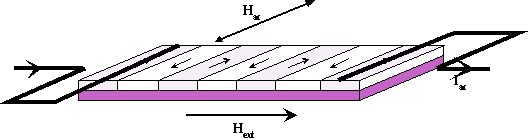
Figure 6.3: Geometry for MI in a magnetic film or ribbon. Hac is the alternating magnetic field produced by the alternating current Iac flowing along the sample and Hext is the external biasing field. Ideally a transverse uniaxial anisotropy is required.


6.5 Results and Discussions

6.5.1 Ribbon samples

To achieve a large MI effect, an ideal sample should possess a magnetic anisotropy which is along the direction of the magnetic field produced by the current as discussed earlier for the case of amorphous wires. In the case of thin films or ribbons, this will be in the form of a transverse, uniaxial, magnetic anisotropy as shown in Figure 6.3. The easy axis is along the direction of the magnetic field generated by the current and this will ensure a large transverse susceptibility. Figure 6.4 represents the MI response as defined by equation (6.4)

Eq. (6.4)(6.4)

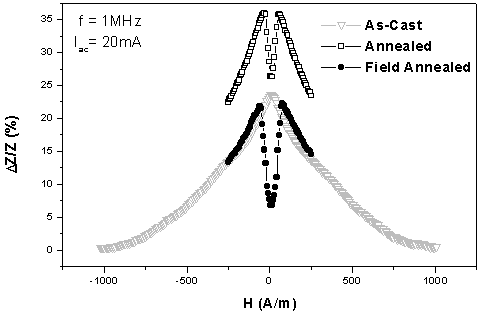
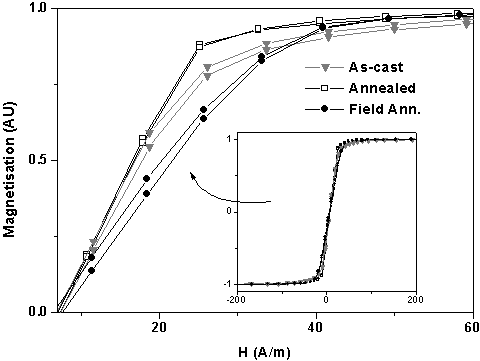
as a function of an external bias field, for three Co-based ribbon samples (VITROVAC® 6025). This ribbon has a small negative magnetostriction (ls=-0.3´10-6 [VAC (1993)]) compared to the METGLAS® ribbon, so one can compare how the responses differ in the two ribbon-based materials which have different magnetic characteristics. The MI curves for the as-cast, annealed and field annealed Co-based ribbons are compared in Figure 6.4. The MI response (23.5%) for the as-cast ribbon displays a maximum when no bias field is present, and decreases on the application of a field. Whereas the MI response (36%) of the annealed sample is of a double peak shape indicting that a uniaxial magnetic anisotropy exists which is not aligned along the length of the sample (i.e. Longitudinal). A double peak is good indication of a magnetisation rotation process. The annealing has relieved the as-cast stresses, and induced a weak transverse uniaxial magnetic anisotropy. The field annealed ribbon also indicates a transverse uniaxial magnetic anisotropy, but the MI response (22%) is much lower compared to the annealed sample. In both cases the MI peaks approximately coincide with the anisotropy field obtained from measurements along the length of the samples which seems to indicate a uniaxial magnetic anisotropy. Comparing the positions of the MI peaks for the annealed and field annealed samples, it is found that the field annealed MI peaks occur at a slightly higher value of field.


Growth and study of magnetostrictive FeSiBC thin films, for device applications, Mannan Ali (1999) 137
(Online Copy)


 Link bar
 Link bar

Email:Mannan.Ali@physics.org Chapter 6: Magneto Impedance investigation
Web: http://members.xoom.com/MannansZone/thesis.html


Magneto impedance ratios

Figure 6.4: Magneto impedance ratios as a function of bias field, for three differently treated Co based ribbons. The dimensions of all Co based ribbon samples were 50mm in length, 5mm in width and 25 mm in thickness. See Figure 6.5 for thermal treatment parameters.


Hysteresis loops

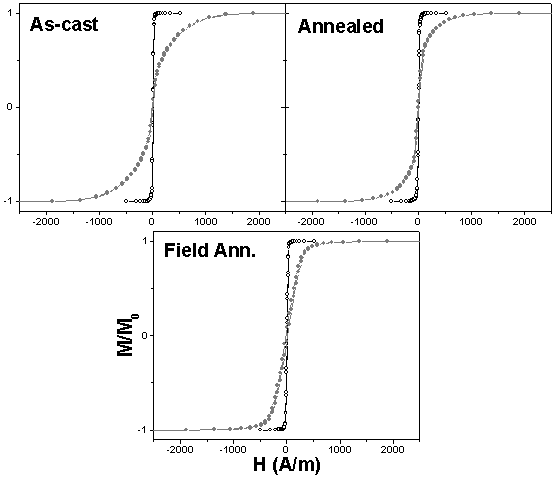
Figure 6.5: Longitudinal hysteresis loops for Co-based ribbons which have under gone different treatments. The thermal treatment used to relieve the growth induced stresses consisted of annealing the samples at 2600C for 60 minutes under a low vacuum (10-2 Torr). The field annealing was performed with the same parameters, with a 0.3T magnetic field applied in the transverse direction.


Magneto impedance ratios

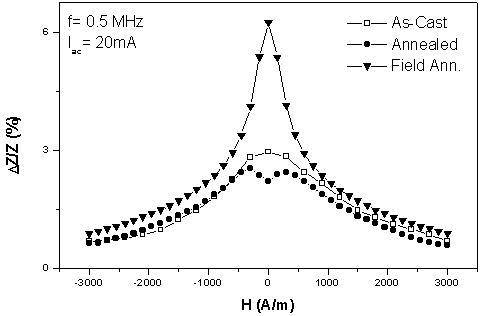
Figure 6.6: Magneto impedance ratios as a function of bias field, for three differently treated METGLAS® ribbons. The dimensions of the samples were 50mm in length, 5mm in width and 25 mm in thickness. See Figure 6.7 for thermal treatment parameters.


Growth and study of magnetostrictive FeSiBC thin films, for device applications, Mannan Ali (1999) 138
(Online Copy)


 Link bar
 Link bar

Email:Mannan.Ali@physics.org Chapter 6: Magneto Impedance investigation
Web: http://members.xoom.com/MannansZone/thesis.html


This is confirmed by the longitudinal hysteresis loops taken along the length of sample (hard axis loop) which are shown in Figure 6.5. One can assume the slightly higher anisotropy has reduced the transverse susceptibility. The non-zero impedance change at the origin for the annealed and field annealed MI curves, indicates that the susceptibility is non-zero and is not totally due to the magnetisation oscillation process (domain rotation). These impedance curves have been obtained at a low 1 MHz frequency where contributions to the effective susceptibility are made up from domain wall movement and domain rotations. Figure 6.6 compares the MI responses obtained for the METGLAS® ribbon samples which were of the same dimensions as those of the Co based ribbon samples and were subjected to similar treatments. The first, most obvious, observation is that, the MI response is dramatically reduced in size. The as-cast sample displays a MI response of only 3%, and the annealed sample exhibits a response of 2.5% and shows a weak, double peak feature. The annealing procedure has the effect of reducing the as-cast stresses, which can be seen from examining Figure 6.7, were the longitudinal loops of the samples are shown. The MI response for the annealed sample seems to imply that, at this low frequency of 0.5 MHz, the domain wall susceptibility has been reduced and the susceptibility due to the domain rotation is becoming dominant.

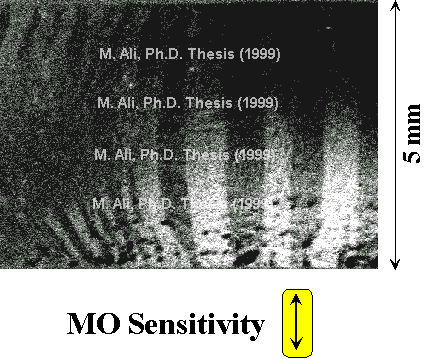
Domain imaging which was found to be a very difficult process for the ribbon samples, mainly due to the dispersion of light because of the roughness of the ribbon surfaces, indicated no visible domain structure for the annealed samples. The MI response of the field annealed sample is 6%, and has a maximum response when no external field is applied. It has been shown that field annealing does produce a uniaxial anisotropy in METGLAS® ribbons [Thomas (1991)] and thin FeSiBC films [Ali et al (1998)]; this is shown in Figure 6.8, where a domain image was obtained for a field annealed METGLAS® ribbon sample. The image obtained is not as clear and sharp as other images presented in this thesis of its thin film counter parts due roughness of the surface, but it does show a uniaxial anisotropy. The image was obtained 10 mm from the end of the sample, and the domain walls appear to be curved, but this is an illusion caused by the sample not being flat. The hysteresis loop shown in Figure 6.7 displays a linear response which is typical for magnetisation rotation, with no visible

Hysteresis loops

Figure 6.7: Longitudinal hysteresis loops for the METGLAS® ribbons which have undergone different heat treatments. The heat treatment used to relieve the growth induced anisotropy was to anneal the samples at 4000C for 60 minutes under a low vacuum (10-2 Torr). The field annealing was performed at the same parameters, with a 0.3T magnetic field applied in the transverse direction.


Growth and study of magnetostrictive FeSiBC thin films, for device applications, Mannan Ali (1999) 139
(Online Copy)


 Link bar
 Link bar

Email:Mannan.Ali@physics.org Chapter 6: Magneto Impedance investigation
Web: http://members.xoom.com/MannansZone/thesis.html


Domain image

Figure 6.8: Domain image of a field annealed METGLAS® ribbon which displays a uniaxial anisotropy. Image obtained 10mm from end of sample. Note sample length 50mm.

hysteresis. Here it appears that the transverse susceptibly is being dominated by domain wall movement since no peaks due to rotational effects are seen.

The ribbon samples (METGLAS® 2605SC [Ms=1.61 T] / VITROVAC® 6025 [Ms=0.55 T]) were of the same dimensions which ensured that any shape-induced demagnetising factors were the same, but the internal demagnetising field was ~3 times as large for the METGLAS® samples (HdµMs); this will have the effect of reducing the susceptibility. The MI responses were obtained at virtually the same frequencies and the two materials have a similar resistivity of 135 mWcm, and therefore any skin effects should have been controlled by the effective susceptibility as indicated by equation 6.2.

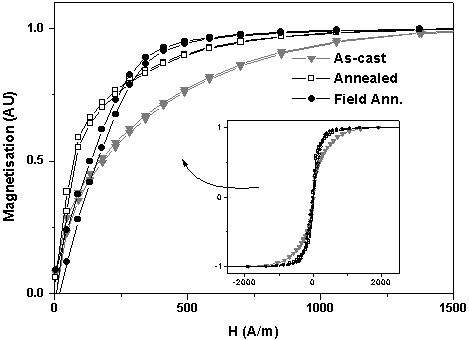
The magnetic anisotropy of the METGLAS® ribbon samples was induced to maximise the transverse susceptibility by field annealing, but the MI response in comparison was poor. From examining Figure 6.9, where the respective loops for the METGLAS® and VITROVAC® ribbon samples are compared, it is clear that the METGLAS® samples are magnetically harder than the VITROVAC® samples, even after undergoing stress relief. The anisotropy field (Hk) for the field annealed sample was 320 A/m for the METGLAS® and only 27 A/m for the VITROVAC®. The coercive field (Hc) for the VITROVAC® samples were less than 0.6 A/m measured by the MH inductive magnetometer, whereas the METGLAS® samples had a coercive field of 15 A/m. It was found that field annealing the METGLAS® ribbon increased its coercive field from its annealed state of 10 A/m. It was not possible to obtain transverse hysteresis loops across the width of the samples, because of the limited size of the sensing

Comparison of METGLAS and VITROVAC

Figure 6.9: Comparison of METGLAS® (solid circles) and VITROVAC® (open circles) ribbon samples. Longitudinal loops taken for the three types of ribbon samples.


Growth and study of magnetostrictive FeSiBC thin films, for device applications, Mannan Ali (1999) 140
(Online Copy)


 Link bar
 Link bar

Email:Mannan.Ali@physics.org Chapter 6: Magneto Impedance investigation
Web: http://members.xoom.com/MannansZone/thesis.html


Impedance and MI response as a function of frequency

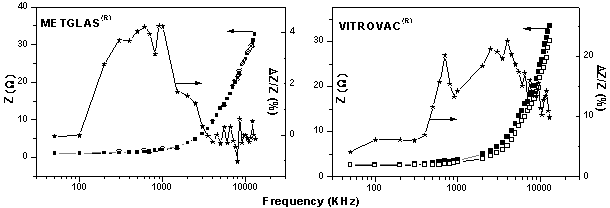
Figure 6.10: The impedance and MI response as a function of frequency, with no applied field (solid symbols), and with an applied field of 5000 A/m (open symbols). The MI response is shown by the solid star symbols for the two samples. Circles represent a field annealed METGLAS® ribbon sample, and the squares represent an annealed VITROVAC® ribbon sample. A current of 20 mA was used in both cases.

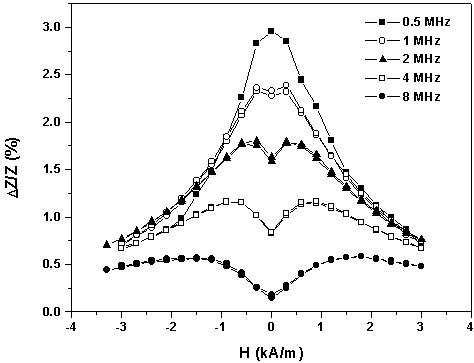
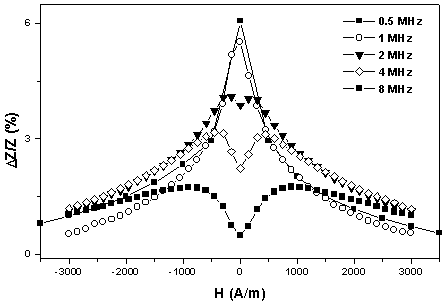
coils of the inductive magnetometer (Section 3.2). However from the MOKE measurements taken from the thin films it was generally found that the easy axis loops had slightly higher coercive fields. The higher coercive fields reduce the domain wall susceptibility, which explains the much lower MI responses for the METGLAS® ribbon samples. Generally it is found that the Co based amorphous alloys have larger permeabilites, lower coercive fields, and lower magnetostriction constants than the Fe based amorphous alloys. A frequency dependence of the MI response was carried out on the annealed VITROVAC® and field annealed METGLAS® samples and the curves are shown in Figure 6.10. The data here was obtained manually using a digital oscilloscope and a frequency generator and not by the automated system. Two frequency sweeps were performed: one with no external biasing field, and a second with biasing field of 5 kA/m. The external biasing field has an effect of reducing the effective transverse susceptibility, and hence the impedance response is reduced. The VITROVAC® sample shows a clear change in the impedance response with an applied field, whereas the METGLAS® sample indicates no visible change, but there is a difference in the MI ratio, as defined by equation 6.4, which shows that there is a small change in the MI on application of a field for the METGLAS® sample. For both samples the MI response increases before falling away with increasing frequency, the largest effect being in the VITROVAC® sample. The impedance response as a function of current was also investigated for the METGLAS® samples but there was no apparent dependency. Figure 6.11 shows a more detailed response of the MI as a function of frequency for an as cast METGLAS® sample. A maximum response of 3% is obtained at a frequency of 0.5 MHz, where the curve has a single peak located at the origin, and decreases to 0.5% at 8 MHz as the frequency is increased. In the process the single peak transforms into a double peak, indicating that the susceptibility due to domain wall movement is being reduced and the susceptibility due to rotational effects is becoming important. It appears that the damping of the domain wall movement occurs at the relatively low frequency of 1 MHz. A similar set of MI curves are obtained for the annealed samples. The MI curves for a field annealed sample is shown in Figure 6.12. Here again, a similar pattern is seen where the single peak becomes a double peak with increasing frequency, which indicates that the domain wall susceptibility is being reduced, and the susceptibility due to domain rotation is becoming dominant at higher


Growth and study of magnetostrictive FeSiBC thin films, for device applications, Mannan Ali (1999) 141
(Online Copy)


 Link bar
 Link bar

Email:Mannan.Ali@physics.org Chapter 6: Magneto Impedance investigation
Web: http://members.xoom.com/MannansZone/thesis.html


frequencies. From the measurements performed on the METGLAS® ribbons, it appears that the MI response is regulated by the susceptibility due to domain wall movement at low frequencies, and this contribution is reduced above a frequency of 1MHz. The above process has also been observed by Tejedor et al (1996), who have concluded that the decrease in MI maxima is a result of a decrease in the transverse susceptibility due to the increased frequency.

As-cast METGLAS

Figure 6.11: MI curves obtained at different driving frequencies for an as-cast METGLAS® 2605SC ribbon sample. The MI response decreases with increasing frequency. Measurements were taken using a current of 20 mA.


Field annealed METGLAS

Figure 6.12: MI curves obtained at different driving frequencies for a field annealed METGLAS® ribbon sample. The MI response decreases with increasing frequency. Measurements were taken using a current of 20 mA.


Growth and study of magnetostrictive FeSiBC thin films, for device applications, Mannan Ali (1999) 142
(Online Copy)


 Link bar
 Link bar

Email:Mannan.Ali@physics.org Chapter 6: Magneto Impedance investigation
Web: http://members.xoom.com/MannansZone/thesis.html


6.5.2 Thin Film Samples

6.5.2.1 FeSiBC amorphous ferromagnetic films

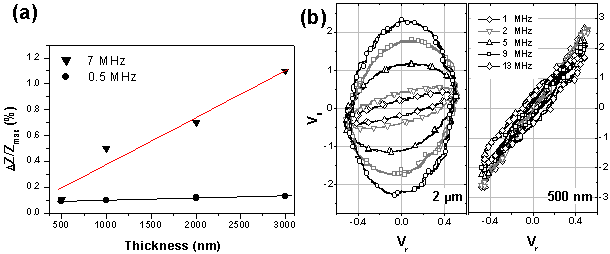
The MI study of the FeSiBC single layered films were performed on four thicknesses (Fig. 6.13) of films which were deposited onto silicon substrates of dimensions 75´5 mm. Due to the limitation imposed by the MI apparatus at the time of these measurements (Section 3.6), the upper frequency limit of the MI analysis was limited to 10 MHz. Ideally, from the point of view of sensor applications it would be preferable if the thin films would operate at relatively low frequencies (1-15 MHz), since it simplifies the electronics needed for the sensor. It was found that the MI response (Fig. 6.13) increased as the thickness of the films increased, indicating that the inductive effect was dependent on the thickness of the film (cross-sectional area). This was verified by current-voltage measurements made by monitoring the voltage across the film and a series standard resistor using an oscilloscope. From Figure 6.13b, it is seen that the 500nm film exhibits a fraction of the inductive effective compared to the 2mm film over a range of frequencies. The susceptibility of the two films were the same, since the MOKE loops were similar and they both had similar coercive fields of 30 A/m. It was found that the largest MI responses appeared in the thicker films, and therefore most of the analysis presented here was carried out on 3mm thick films. The as-deposited films possessed the radial magnetic anisotropy [Ali et al (1998)] which is induced by the magnetron effect, and therefore the samples had to be thermally treated to remove, or induce, a uniform transverse uniaxial anisotropy. A number of samples were also examined in their deposited state.

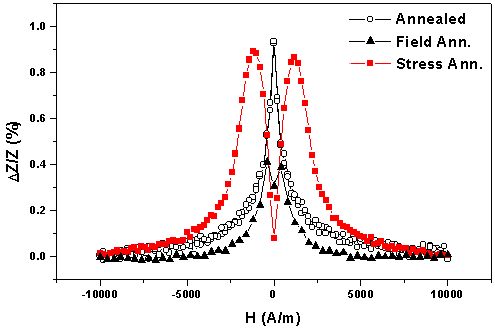
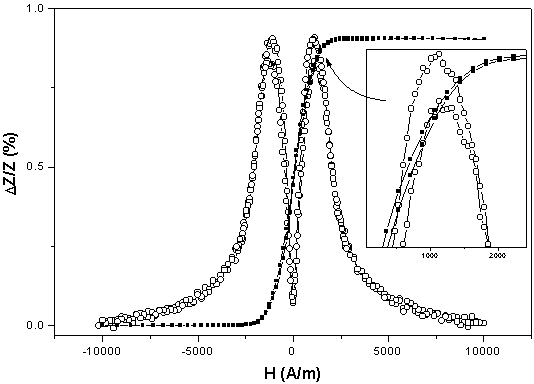
As previously seen for the METGLAS® ribbon samples, two types of MI curves were obtained for the thin films; these are shown in Figure 6.14. The annealed samples display a single MI peak located at the origin, whereas the stress annealed and as-deposited samples display a double peak MI response. The maximum MI response was found to be approximately 1% for these samples. Surprisingly the field

MI response as a function of thickness

Figure 6.13: Figure (a) displays the MI response obtained from a variation in the thickness of the FeSiBC thin films at 0.5 MHz and 7 MHz. The solid lines are included as a guide only. (b) Current-voltage measurements over a range of frequencies.


Growth and study of magnetostrictive FeSiBC thin films, for device applications, Mannan Ali (1999) 143
(Online Copy)


 Link bar
 Link bar

Email:Mannan.Ali@physics.org Chapter 6: Magneto Impedance investigation
Web: http://members.xoom.com/MannansZone/thesis.html


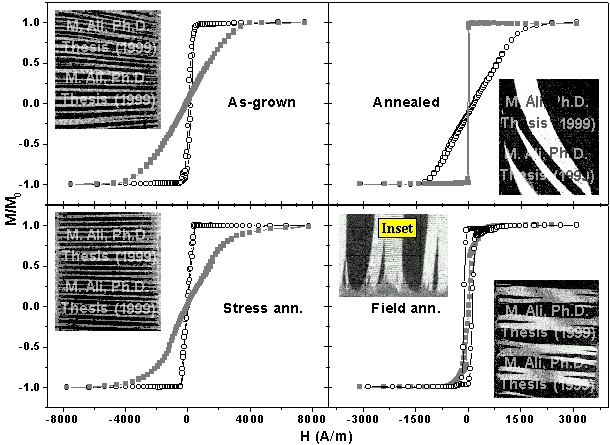
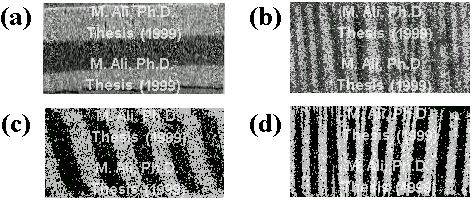
annealed samples displayed a smaller response (0.4%) compared to the other three types of samples, and exhibited a weak double peak feature. From the results obtained from the ribbon material, it was expected that the field annealed samples would display the largest effect. The field annealed samples were obtained from the same deposition run as the other samples shown in Figure 6.14. This removed the possibility of the material being magnetically different, even though it has been shown that samples are very reproducible from consecutive deposition runs, and therefore some other mechanism is at work. Figure 6.15 represents the typical domain structures for the four types of samples used, in their remanent state, along with their corresponding hysteresis loops. For the as-grown, stress annealed, and field annealed samples, the domain images display a uniaxial anisotropy induced along the transverse direction (across the width), whereas the annealed samples have an easy axis along the longitudinal direction (along the length). The hysteresis loops for the annealed sample indicates a significant anisotropy has been induced. This has been attributed to two effects: the 15:1 aspect ratio of the samples creates a shape anisotropy which tries to align the moments along the length of the sample, and because no other agent is present which opposes this, during the annealing treatment, it creates an easy axis along the length of the samples. Secondly as described in Chapter 3, the samples are annealed in a solenoid observation furnace where a small field exists along the length of the coil, and which also prefers to align the magnetisation along the length of the samples. The curved domains are presumed to be the consequence of this AC field not being aligned perfectly along the axis of the samples. The uniaxial domain structure of the as-deposited samples is perpendicular to the long axis of the samples in the central region, but deviates away towards the ends of the samples as shown in Chapter 5. The anisotropy induced in the as-deposited and stress annealed samples is sufficiently large that it prevents the formation of closure domains, which would require the domain magnetisation to point along the hard axis. The energy of the system is minimised by the formation of reverse spike domains, and by the

 Magneto impedance ratios

Figure 6.14: Magneto impedance ratios as a function of bias field for three differently treated FeSiBC films. The sample had dimensions of 75mm in length, 5mm in width and 3 mm in thickness [Ali et al (1999)]. (7MHz).


Growth and study of magnetostrictive FeSiBC thin films, for device applications, Mannan Ali (1999) 144
(Online Copy)


 Link bar
 Link bar

Email:Mannan.Ali@physics.org Chapter 6: Magneto Impedance investigation
Web: http://members.xoom.com/MannansZone/thesis.html


Domain images and MOKE loops

Figure 6.15: Domain images and their respective MOKE hysteresis loops for samples shown in Figure 6.14. MOKE loops were measured at the centres of each sample. The inset for the field annealed sample indicates that closure domains exist together with reverse spike domains.


Field annealed

Figure 6.16: A FeSiBC thin film which was field annealed at the same time as the sample shown in Figure 6.15. This sample has an aspect ratio which is 3:1. In this case there are only reverse spike domains.


Growth and study of magnetostrictive FeSiBC thin films, for device applications, Mannan Ali (1999) 145
(Online Copy)


 Link bar
 Link bar

Email:Mannan.Ali@physics.org Chapter 6: Magneto Impedance investigation
Web: http://members.xoom.com/MannansZone/thesis.html


narrow domain widths, which reduce the demagnetising effects. The domain structure of the field annealed samples, is that of flux closure type where closure domains exist (see inset) at the edges together with reverse spike domains. In this case the anisotropy induced is relatively weak, and therefore much larger domains exist because of the formation of flux closure domains. It is assumed the closure domains are a consequence of the shape anisotropy, since Figure 6.16 shows the domain structure of a film on complete glass slide (aspect ratio 3:1) which was field annealed at the same time as the sample shown in Figure 6.15. Here the domain structure is uniaxial with reverse spike domains present only, and it therefore seems the closure domains are due to the shape anisotropy in the long narrow samples. We know from the samples which have undergone stress relief, that the shape anisotropy and the small magnetic field creates a significant anisotropy field of ~1500A/m. The easy axis coercive field, is notably larger (200 A/m) in comparison to the other three sample types. It should be noted the larger coercive field appears to be due to the closure domains in combination with the reverse spike domains which seem to prevent the free movement of the main 1800 degree domain walls.

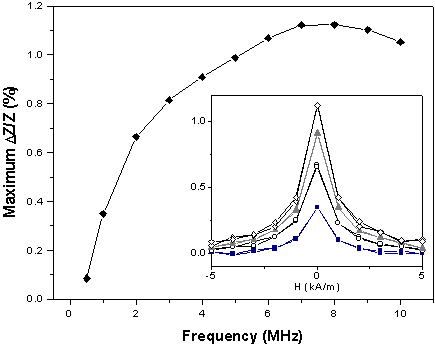
Domain images have verified that the domain walls are pinned at the closure domains and do not move as freely as the 1800 domain walls in the other samples. The higher coercive fields reduce the effective transverse susceptibility, especially the contribution from domain wall movement of the sample; this explains why the field annealed samples display a much lower MI response than the other thin film samples and the ribbon samples. The MI response was also investigated as a function of current amplitude for the four types of samples, but no significant dependence was found. Figure 6.17 shows the maximum MI response as function of frequency for a typical sample which has been annealed (stress relieved). The inset shows a number of selected MI curves from points on the main graph. The opposite effect is seen here, compared to that of the ribbon samples. The MI response for the annealed films increases with frequency, whereas it decreases for the ribbon samples. The effective susceptibility

Maximum MI response

Figure 6.17: The maximum MI response a function of the current frequency for a 3mm FeSiBC annealed (stress relieved) film. The inset shows the MI curves obtained at a number of frequencies. [1MHzÞsolid squares, 2MHzÞopen circles, 4MHzÞsolid triangle, 8MHzÞopen diamond].


Growth and study of magnetostrictive FeSiBC thin films, for device applications, Mannan Ali (1999) 146
(Online Copy)


 Link bar
 Link bar

Email:Mannan.Ali@physics.org Chapter 6: Magneto Impedance investigation
Web: http://members.xoom.com/MannansZone/thesis.html


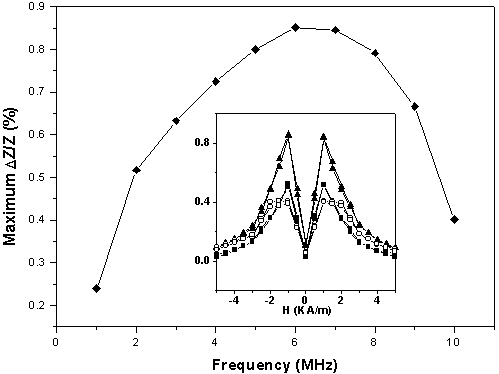
of the films is controlled by domain rotation and not by domain wall movement as in the case of the ribbon samples. The curve exhibits three regions: initially the MI increases rapidly - this is due to increasing rotational effects, it then increases linearly with frequency between the region 2-7 MHz (reactance a Freq), before decreasing. The shape of the MI curves is a single peak located at the H=0 for all frequencies. This is what would be expected, since both hysteresis loops and domain images indicate that the easy axis is parallel to the current direction in these annealed samples, and therefore the DC axial field has the effect of increasing the field-imposed anisotropy, which reduces the transverse rotational susceptibility on the onset of the applied field. Similar responses were found for the as-deposited and stress annealed samples, and Figure 6.18 shows a typical response for a stress annealed sample as a function of frequency. The MI curves for these samples exhibit a double peak indicating domain rotation, since the magnetisation is no longer parallel to the applied field. The impedance increases to its maximum value, at the anisotropy field, because there is an increase in the rotational transverse susceptibility as the magnetisation is rotated towards the direction of the current by the external field. The decrease in the impedance with further increase of the external field is a result of the increasing field imposed anisotropy which reduces the transverse rotational susceptibility. An important result is obtained from the MI curves shown in the inset of Figure 6.18. When no external field is present, the MI response has a value of almost zero, at all frequencies (there is a slight decrease on increasing frequency). This indicates that the contribution to the transverse susceptibility from domain wall movement is very weak or negligible; this would be plausible since the easy axis coercive fields are higher. The finite value of the MI at H=0 may be due to the easy axis not being aligned perfectly perpendicular to the current direction, or there is probably a distribution of the easy-axis orientation, which is a reasonable assumption; this would lead to a small domain rotation contribution to the susceptibility.

Maximum MI response

Figure 6.18: The maximum MI response a function of the current frequency for a 3mm FeSiBC stress annealed film. The inset shows the MI curve obtained a number of frequencies. [1MHzÞ solid squares, 6MHzÞ solid triangle, 10MHzÞ open circles].


Growth and study of magnetostrictive FeSiBC thin films, for device applications, Mannan Ali (1999) 147
(Online Copy)


 Link bar
 Link bar

Email:Mannan.Ali@physics.org Chapter 6: Magneto Impedance investigation
Web: http://members.xoom.com/MannansZone/thesis.html


Stress annealed

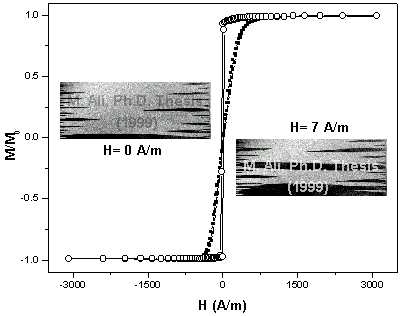
Figure 6.19: MI curve from a stress annealed FeSiBC film exhibiting hysteresis. The corresponding MH loop has been over-laid after being re-scaled, hence arbitrary units are used. Both the MI curve and MH loop indicate a magnetisation rotation process. The inset shows the hysteresis present around the anisotropy field. (Freq.=7MHz, Iac=5mA) [Ali et al (1999)].

Comparing the MI curves to those of the METGLAS® ribbons shown in Figures 6.11 & 6.12, the MI response at H=0 decreases to zero with increasing frequency as the contribution to the susceptibility from domain wall movement is restricted. This is in agreement with what is found in the present work for the FeSiBC films, where the response increases from zero due to the increasing rotational effects. The impedance response in these films is controlled by the process of domain rotation, which is a small effect in these samples. Figure 6.19 is the MI response of a stress annealed sample, along with its corresponding hard axis hysteresis loop. The shape of the hysteresis loop is that of a typical magnetisation rotation process, and the MI peaks coincide with the anisotropy field obtained from the hysteresis loop. The initial slopes of the MI curve are also linear, which indicates a rotational process.

It is found that the MI effect is not hysteresis free, as shown by a recent publication by Sinnecker et al (1998)] were hysteresis effects are shown to be present in MI curves. It was found that the hysteresis effects in the MI curves coincided with the hysteresis observed in the magnetic hysteresis loops; this indicated that the hysteresis was a direct result of the magnetisation process. This is shown in the inset of Figure 6.19 where hysteresis effects were found in the MI curves obtained from the FeSiBC film samples. The hysteresis in the MI curves coincides with the magnetic hysteresis of the magnetic loops. The peaks for the positive field cycle are shown, where a small hysteresis effect can be observed.

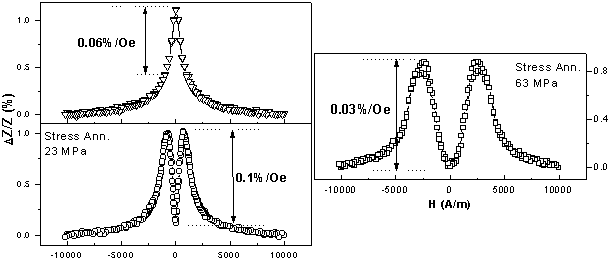
There was no significant difference found in the maximum MI response for either the transverse or longitudinal uniaxial anisotropy. The only difference between the two domain structures was the resulting shape of the magneto impedance curve. As shown in Figure 6.20, the typical MI response for an annealed sample was approximately 1% in an applied field of 10 kA/m, and the sensitivity to the magnetic response in the linear region is approximately 0.06%/Oe, which does not compare at all well with reported sensitivities of a few hundred percent per oertsed (1Oe=79.58 A/m) for non-film based materials. Samples with transverse domain structures exhibited sensitivities of only 0.1%/Oe depending upon how large an anisotropy had been induced. A larger anisotropy simply decreases the sensitivity,


Growth and study of magnetostrictive FeSiBC thin films, for device applications, Mannan Ali (1999) 148
(Online Copy)


 Link bar
 Link bar

Email:Mannan.Ali@physics.org Chapter 6: Magneto Impedance investigation
Web: http://members.xoom.com/MannansZone/thesis.html


MI curves

Figure 6.20: MI curves obtained from an annealed and two stress annealed FeSiBC films showing the sensitivity to the magnetic response. (Freq.=7MHz, Iac=5mA). Notice that in the film which is stress annealed with a larger applied stress, the MI peaks occur at a higher field value.

since a larger field is needed to obtain the same MI change. A positive and promising result from MI curves for samples with a transverse domain structure, is that the MI response is initially linear with field (Fig. 6.20) and therefore could be used as the basis of a field sensor, if the sensitivity could be increased. One possible option is to operate at a much higher driving frequency (>400MHz) where a skin effect would be present and the larger GMI effect could be used. The alternative method is to enhance the MI effect by using layered films as reported by Morikawa et al (1997) as discussed below.

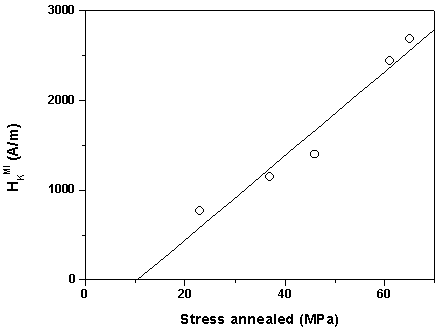
In Chapter 5 it has been shown that the anisotropy field varies linearly with strain, and one can measure the resulting anisotropy field as a function of strain very accurately using MOKE; this therefore could be utilised as a stress sensor. A similar principle can be used here, using the MI effect instead of MOKE, to obtain the strain induced anisotropy. Figure 6.20 shows the MI response of two samples which were stress annealed with two different applied stresses and the MI peaks occur at two different fields. Unfortunately, the MI measurements were carried out in Madrid, where it was not possible to simultaneously vary the strain and to obtain MI measurements on the same sample. Instead a number of films with identical dimensions were stress annealed as described in Chapter 5 so as to create a range of strain induced anisotropies. The results are shown in Figure 6.21, where the anisotropy field (HKMI), is obtained from the MI peaks. Since the MI effect is due to the magnetisation rotation process, the MI peaks can be taken to represent the stress induced anisotropy field. A domain rotation model for the susceptibility is discussed below where it is shown that the MI in the film samples is controlled by the magnetisation rotation process. The data obtained is not as linear as was expected, but considering that only one set of five samples was used, the data does look promising for future work. From the slope of the best fit line (see Chapter 5), one obtains a value for the magnetostriction constant of 27±11.2ppm, which is lower than the expected value. When the measurements were carried out on these samples, it was over-looked at the time that the electrical contacts for MI measurements were made 5mm from the ends of the samples which were 75mm in length. This meant the strain induced anisotropy was not linear between the two electrical contact points along the whole length of the samples as discussed in


Growth and study of magnetostrictive FeSiBC thin films, for device applications, Mannan Ali (1999) 149
(Online Copy)


 Link bar
 Link bar

Email:Mannan.Ali@physics.org Chapter 6: Magneto Impedance investigation
Web: http://members.xoom.com/MannansZone/thesis.html


Section 5.8.3.3. This meant that the anisotropy field measured by the MI effect did not relate to the induced stress. The varying anisotropy causes the MI peaks to occur at lower fields because of an averaging effect. A more linear response would be expected if the contacts were made 10mm apart on the central region of the sample where the strain is approximately uniform, and if the stress was varied on the same sample. This would ensure that the anisotropy field measured by the MI could be correlated to the stress applied, which would produce a more linear response as shown in Section 5.8.

Anisotropy field obtained from MI measurements

Figure 6.21: The anisotropy field obtained from MI measurements for samples which have been stress annealed with different applied stresses. (Freq.=7MHz, Iac=5mA)


Growth and study of magnetostrictive FeSiBC thin films, for device applications, Mannan Ali (1999) 150
(Online Copy)


 Link bar
 Link bar

Email:Mannan.Ali@physics.org Chapter 6: Magneto Impedance investigation
Web: http://members.xoom.com/MannansZone/thesis.html


6.5.2.2 CoFeB amorphous ferromagnetic films

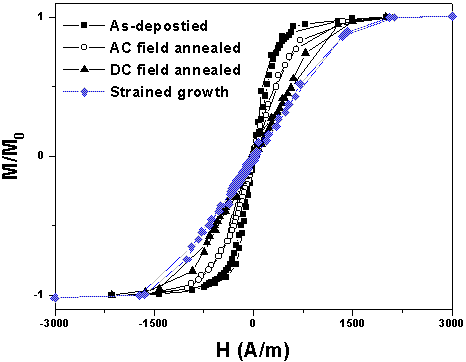
The thickness of the Co76Fe4B20 thin films which were deposited onto glass substrates ranged from 1.5 to 4.3 mm. The anisotropies for these particular samples were induced by strained growth, AC and DC field annealing. In the case of the strained growth, the negative magnetostriction produced an easy axis along the length of the samples upon removal of the externally applied stress. In order to obtain a transverse domain structure, samples were then cut 2mm by 20mm in such a way that a transverse uniaxial anisotropy existed across the width of the final samples. Typical domain structures for the different induced anisotropies are shown in Figure 6.22. The strained growth and the DC field annealed samples all display a transverse uniaxial domain structure, with reverse spike domains at the edges. The as-deposited films exhibit a longitudinal anisotropy and this is attributed to the magnetron effect. The samples which underwent an AC field anneal, have a slightly different domain structure. Here the stripe domains have the form of an inverted "S" [Garcia et al (1998)], where the central region of the domain walls make an angle of approximately 170 with the transverse direction, and this increases further to approximately 650 towards the edges. The domain structure is determined by the net anisotropy between the AC field annealed, as-cast and shape-induced anisotropies. As shown in Figure 6.22a, the as-cast

Domain structures

Figure 6.22: Domain structures for remanent state for an (a) as-deposited, (b) strained growth, (c) AC field annealed, (d) DC field annealed CoFeB thin film samples. Thermal treatments performed at 3000C at a field of 1.5kA/m (50 Hz) and 4kA/m respectively in an argon atmosphere for 1 hour. Domain images obtained in Madrid [Garcia et al (1999)].


Hysteresis loops

Figure 6.23: Longitudinal hysteresis loops obtained from the samples described using VSM. Measurements carried out on Madrid.


Growth and study of magnetostrictive FeSiBC thin films, for device applications, Mannan Ali (1999) 151
(Online Copy)


 Link bar
 Link bar

Email:Mannan.Ali@physics.org Chapter 6: Magneto Impedance investigation
Web: http://members.xoom.com/MannansZone/thesis.html


samples have a longitudinal domain structure, which the field annealing needs to overcome. Samples which were AC field annealed at a lower temperature of 2500C (500C lower), were found to have a more pronounced curvature of the domain walls. In this case, the central region of the domain walls made an angle of 520, indicating that the anisotropy induced by AC field annealing is much weaker at 2500C. From this one can infer that the "S" shaped domain structure is a result of the competing anisotropies. The "S" shaped domains also appear to remove the need for reverse spike domains, due to the curving domains towards the longitudinal direction as they approach the edges of the samples. The hysteresis loops for the four types of samples are shown in Figure 6.23. The samples have coercive fields in the range of 12 to 30 A/m. The strained growth and AC field annealed samples displayed smaller coercive fields compared to the other two types of samples. All samples displayed a small remanent magnetisation which correlated well with the remanent domain images shown in Figure 6.22, where approximately equal amounts of anti-parallel domains existed. As one would expect, the largest anisotropy was attained for the strained growth samples where anisotropy fields of approximately 1750 A/m were induced.

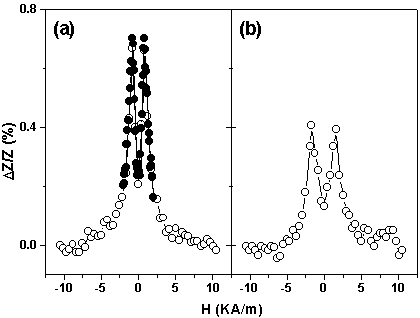
The DC and AC field annealed treatments induced anisotropy fields of 820 A/m and 1100 A/m respectively. Figure 6.24 shows the typical MI responses obtained from the AC field annealed and strained growth samples. No appreciable MI responses were found for the other samples over the range of frequencies and currents investigated. It was found that the largest MI response of 0.7% was measured from the AC field annealed samples, and a MI response of 0.4% from the stress annealed samples. The larger MI response for the AC annealed samples correlates to the lower coercive fields of the samples compared to the others. As with the FeSiBC films, it was found that the MI response is controlled by the process of magnetisation rotation, since the MI response increases with frequency. The MI curves exhibit a double peak which correlates with the transverse magnetic anisotropy and the peaks correspond to the anisotropy field, where the susceptibility due to magnetisation rotation is a maximum. So, it appears therefore that for both the FeSiBC and CoFeB thin films, the MI response is controlled by domain rotation.

MI curves

Figure 6.24: MI curves obtained from (a) AC field annealed, and (b) strained growth Co76Fe4B20 film samples (3mm). Measurements carried out at 5MHz at current amplitude of 5mA. [Garcia et al (1999)].


Growth and study of magnetostrictive FeSiBC thin films, for device applications, Mannan Ali (1999) 152
(Online Copy)


 Link bar
 Link bar

Email:Mannan.Ali@physics.org Chapter 6: Magneto Impedance investigation
Web: http://members.xoom.com/MannansZone/thesis.html


6.5.2.3 Layered FeSiBC amorphous ferromagnetic films with copper

Morikawa et al (1997) have demonstrated that by using multi-layered film structures, it is possible to increase the MI ratios of thin films without increasing the current frequency. MI ratios of 140% have been obtained at 1MHz, giving sensitivities of 15%/Oe, which have been shown to be three orders of magnitude larger than the respective single layered films of similar thicknesses. The sensitivity is further increased by a very modest increase in frequency to 10MHz to give sensitivities of 49%/Oe. The MI ratios and sensitivities obtained here are the largest values reported for thin films at these particularly low operating frequencies, and are comparable to sensitivities for some amorphous wires and ribbons. A schematic drawing of the MI element used by Morikawa et al is shown in Figure 6.25a. The MI element consists of a conductive non-magnetic core, which is surround by two layers of amorphous ferromagnetic material in which a transverse uniaxial anisotropy has been created. The magnetic material has a coercive field of 25A/m and a well defined transverse uniaxial anisotropy. Since the resistance of the conductive layer is much lower than the magnetic layers, the majority of the current flows through the conductive layer. The conductive layer also has the effect of reducing the resistance of the whole element. Typical results obtained by Morikawa et al are shown in Figure 6.25b, where the MI response as a function of frequency is shown for a single layered film of CoSiB, and a

Layered films [Morikawa et al (1997)]

Figure 6.25: Layered films [Morikawa et al (1997)]. (a) Schematic-cross sectional view of the layered structure used for MI measurements. (b) MI dependence as a function of frequency for CoSiB film and layered films with conductive materials shown. (c) The dependence of the change in resistance as a function of frequency for the same samples as shown in Figure (b). (d) The corresponding reactance changes observed as a function of frequency. These results clearly indicate that the MI response appears to be dominated by the changes in the resistance, even though the skin effect is negligible at these low frequencies.


Growth and study of magnetostrictive FeSiBC thin films, for device applications, Mannan Ali (1999) 153
(Online Copy)


 Link bar
 Link bar

Email:Mannan.Ali@physics.org Chapter 6: Magneto Impedance investigation
Web: http://members.xoom.com/MannansZone/thesis.html


number of layered structures. The layered structures, except for the structure with titanium as the conductive layer, display a dramatic increase in the MI response compared to the single layered film. This increase is attributed to the insertion of the conductive layer, which enhances the resistance changes because the conductive layer reduces the resistance of the entire structure. Separate measurements carried out by Morikawa et al on the inductive and resistive components (shown in Fig. 6.25c,d) of the impedance have shown that very large resistance ratios (DR/R) exist for these structures at very low frequencies (1MHz), where there is no significant skin effect. These large resistance changes dominate the impedance changes, and have been shown to be a result of the difference between the resistivity of the conductive layer and the magnetic layer. The electrical resistivity of the CoSiB film is 30 times larger than that of the copper or silver and therefore most of the current flows through the inner conductive layer. Whereas the resistivity of the CoSiB compared to the titanium layer is only 2.5 times as large. Here the current is no longer confined to the titanium layer, and the whole structure is equivalent to the single layer film. It was therefore concluded by Morikawa that the difference between the resistivity of the inner and outer layers is the cause of these large resistance changes, which therefore appear in the impedance measurement.

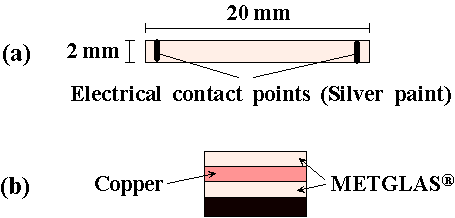
To increase the MI response of the FeSiBC single layer films investigated in this thesis, a number of multi-layered structures were deposited by magnetron sputtering. The purpose of this was to ascertain if similar results could be obtained to those obtained by Morikawa et al (1997). This would then make the results obtained for the single layer films much more attractive for sensor applications because of the increased sensitivity. Figure 6.26 shows the structure and dimensions of the layered FeSiBC films which were deposited using copper as the conductive layer. The resistivity of the single layered FeSiBC films is equal to that of the CoSiB films, and therefore the difference in resistivity will be similar to the structures used by Morikawa. At the time, there was a problem with the masking procedure, which prevented the masking of layers during the growth deposition of the films; this restricted the structures and dimensions of the samples. Consequently the sputtered magnetic layers sputtered did not form a

Plan view of layered films used

Figure 6.26: (a) Plan view of layered films used. (b) Schematic cross-sectional view of the layered structure which was fabricated for MI measurements.


Sample set Ref. FeSiBC/Cu/FeSiBC
SA1 1.5mm / 2mm /1.5mm
SA2 400nm / 300nm / 400 nm
SA3 400nm / 150nm / 400 nm

Table 6.1: Layer thicknesses of the layered films.


Growth and study of magnetostrictive FeSiBC thin films, for device applications, Mannan Ali (1999) 154
(Online Copy)


 Link bar
 Link bar

Email:Mannan.Ali@physics.org Chapter 6: Magneto Impedance investigation
Web: http://members.xoom.com/MannansZone/thesis.html


closed magnetic structure as did the samples produced by Morikawa. For this preliminary investigation, the structures were simply layered as a sandwich structure as shown in Figure 6.26 were the magnetic layers were of equal thickness. Three sets of these layered films where deposited and are shown in Table 6.1.

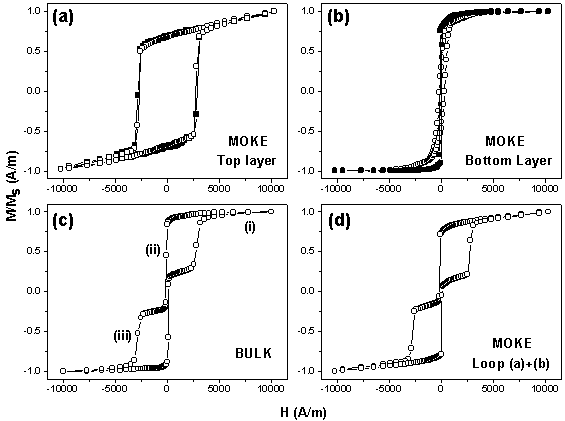
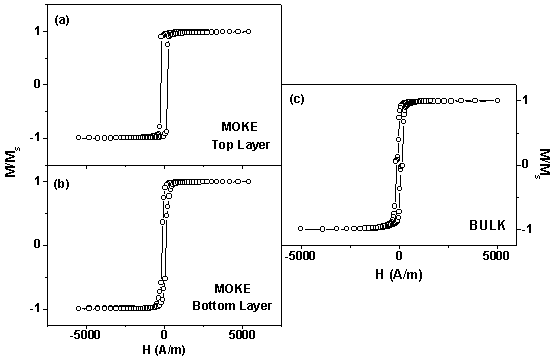
The as-deposited samples for all three sets of samples exhibited a two phase magnetic hysteresis loop, where the two FeSiBC layers were switching independently of each other. Figure 6.27 shows typical loops obtained from these samples. Figures 6.27a and 6.27b represent the MOKE loops obtained from the top and bottom FeSiBC layers. A number of samples were grown on Corning 7059® glass which allowed the characterisation of the bottom layer (see MOKE chapter). The MH curves clearly indicate that the two layers are magnetically different. The top layers were found to have coercive fields of approximately 2.5 kA/m, whereas for the bottom FeSiBC layers, the coercive fields were approximately 150 A/m. The high coercive field of the top layer is mainly attributed to the copper layer inducing stress into the FeSiBC film because of the different thermal expansion coefficients of the FeSiBC (5.9 ppm/0C ) and the copper (1.8 ppm/0C). The effects of the copper surface itself should not be neglected since the top layer is no longer being deposited onto an amorphous substrate, and may introduce stress into the film. Annealing the sample relieves the stress since the coercive field of the top layer is dramatically reduced. (Fig. 6.29).

Figure 6.27c is the bulk hysteresis loop, which is sensitive to the average magnetisation of the layered structure. Here the MH loop switches at two distinct points which coincide with the coercive fields of the MOKE loops obtained from the top and bottom layer respectively. Figure 6.27d is the resultant MOKE loop obtained after combining the two respective MOKE loops of the top and bottom layer. The loop obtained is very similar to that of the bulk hysteresis loop, which indicates that the MOKE loops are representative of each layer and the magnetisation processes in the two layers seem to occur

Layered FeSiBC film

Figure 6.27: Hysteresis loops from layered FeSiBC film as-deposited. (a) Orthogonal MOKE loops obtained from the top magnetic layer. (b) Orthogonal MOKE loops of the bottom magnetic layer obtained through the glass substrate. (c) Bulk hysteresis loop which is sensitive to both layers simultaneously. (d) Combination of MOKE loops (a)+(b).


Growth and study of magnetostrictive FeSiBC thin films, for device applications, Mannan Ali (1999) 155
(Online Copy)


 Link bar
 Link bar

Email:Mannan.Ali@physics.org Chapter 6: Magneto Impedance investigation
Web: http://members.xoom.com/MannansZone/thesis.html


independently. At saturation (i) the magnetisations in both layers are parallel to each other, while at some intermediate level (ii), the magnetisations of the lower layer switches and the magnetisation in the two layers are now anti-parallel. As the field is increased further (iii), the top layer switches and the magnetisations are now parallel in both layers. As mentioned earlier, equal thicknesses of the magnetic layers were deposited. This means therefore that the magnetisations in the two magnetic layers are different, since the magnetisations in each layer switches by different amounts ((ii),(iii)). It appears that the top layer, which is magnetically harder, has a lower magnetic moment than the lower layer. This is assumed to be due to the incorporation of more copper into the second layer. As discussed in Chapter 3, the sputtering process will remove material from all surfaces of the system which are in contact with the plasma, and such material will therefore be incorporated into the film which is being

X-ray diffraction

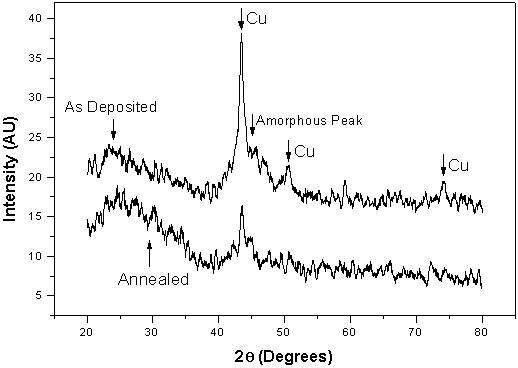
Figure 6.28: X-ray diffraction q-2q scans using CuKa radiation before and after thermal stress relief treatment of FeSiBC layered films.

Hysteresis loops

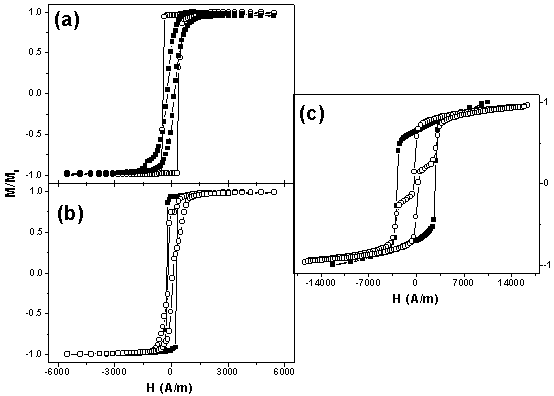
Figure 6.29: Hysteresis loops from a layered FeSiBC film after undergoing stress relief. (a) MOKE loop obtained from the top magnetic layer. (b) MOKE loop of the bottom magnetic layer obtained through the glass substrate. (c) Bulk hysteresis loop which is sensitive to both layers simultaneously. The two layers are now magnetically similar.


Growth and study of magnetostrictive FeSiBC thin films, for device applications, Mannan Ali (1999) 156
(Online Copy)


 Link bar
 Link bar

Email:Mannan.Ali@physics.org Chapter 6: Magneto Impedance investigation
Web: http://members.xoom.com/MannansZone/thesis.html


deposited. Since the structures were fabricated by depositing alternative layers of FeSiBC/copper/ FeSiBC, this meant that copper was introduced into the FeSiBC. However this was unavoidable. X-ray analysis of these samples implied that the as-deposited FeSiBC layers were amorphous, and sharp copper peaks existed because of the copper layer. This is shown in Figure 6.28 where the peaks have been labelled. Upon annealing the samples, X-ray diffraction revealed that the copper peaks were now less intense; this seems to imply that the copper had diffused into the magnetic layers. The X-ray analyses were carried out in Madrid were CuKa radiation was used. This, unfortunately, gave a copper peak on top of the amorphous peak which masked the amorphous peak. However there appeared to be no real change after the annealing process, which seems to suggest that there has been no substantial change in the amorphous phase (FWHM). The annealing process relieved the stress, primarily in the top magnetic layer, which made the two layers magnetically similar after the treatment. This is shown in Figure 6.29, where MOKE and bulk hysteresis loops are shown. The MOKE loops show that the two magnetic layers are now similar and have coercive fields of 120 and 200 A/m. The bulk hysteresis loop is still sensitive to the small difference in the two layers, but they now both switch similarly. This is assumed to be due to the equal quantities of copper which has diffused into the two layers.

The samples were annealed and field annealed to ensure that the two magnetic layers were magnetically similar so that the magnetic properties were as favourable as possible for the MI measurements. The coercive fields were approximately three times larger for these layered structures than for the single layered films. Both MOKE and domain imaging indicated that field annealing did not produce a transverse uniaxial anisotropy. The domain studies on these particular samples for the as-deposited and annealed films did not reveal any domain structure. It was expected that the lower magnetic layer would display the radial anisotropy for the as-deposited structures, but no domains were visible. It is assumed

Loops from layered FeSiBC films

Figure 6.30: Typical hysteresis loops from layered FeSiBC films. (a) Transverse (open circles) and longitudinal (solid squares) MOKE loops for field annealed film. (b) Transverse (open circles) and longitudinal (solid squares) MOKE loops for an annealed film. (MOKE). (c) Transverse loops obtain by VSM (open circles), and MOKE (solid squares) from an as-deposited film.


Growth and study of magnetostrictive FeSiBC thin films, for device applications, Mannan Ali (1999) 157
(Online Copy)


 Link bar
 Link bar

Email:Mannan.Ali@physics.org Chapter 6: Magneto Impedance investigation
Web: http://members.xoom.com/MannansZone/thesis.html


that either the copper has diffused into the layers during the growth because of the substrate temperatures of around 1000C, or the differing thermal expansion coefficients of the two films and substrate, have induced residual stresses. Typical loops for the annealed, field annealed and as-deposited samples used for the MI measurements are shown in Figure 6.30.

The MI measurements carried out on these layered films did not display any MI response over a range of frequencies and current amplitudes. It is not clear why not even a small response was seen for the samples SA1, which were equivalent to a single layered 3mm thick film where changes of 1% were seen. A plausible argument is that this is due the copper which has diffused into the magnetic layers. The hysteresis loops show that the copper has the effect of increasing the coercive fields of the magnetic layers. The higher coercive fields will therefore reduce the effective transverse susceptibility of the material.

It seems likely that these preliminary investigations of layered structures for MI measurements have been impaired by the diffusion of the copper into the magnetic layers. This has two effects; one is that it degrades the magnetic properties, and secondly, it does not produce a distinct layered structure. The diffusion of the copper is also expected to decrease the difference in the resistivity of the two materials, on which the MI in the layered structures is shown to be dependent. Even though the magnetic layers used here do not form a closed magnetic loop for the flux as used by Morikawa et al, it was still anticipated that responses larger than one percent would be obtained. The problem of the copper diffusing into the magnetic layers needs to be addressed before one can conclude that the FeSiBC layered films are not viable for the MI effect as seen by Morikawa et al. It should be noted that Cu is insoluble in Co. An alternative conductive layer would be silver, which is known to have a very low solubility in most materials. Silver also has a lower resistivity than Cu, and from the results shown in Figure 6.22 it displays the largest MI changes for the layered structures.


Growth and study of magnetostrictive FeSiBC thin films, for device applications, Mannan Ali (1999) 158
(Online Copy)


 Link bar
 Link bar

Email:Mannan.Ali@physics.org Chapter 6: Magneto Impedance investigation
Web: http://members.xoom.com/MannansZone/thesis.html


6.6 Domain rotational model for the effective transverse susceptibility

From the results and discussions of the MI effect for the thin films, it appears that the MI behaviour is controlled by contributions to the susceptibility from the process of domain rotation. The higher coercive fields for the films has effectively suppressed the contribution from domain wall movement. At frequencies below 1 MHz there was found to be no substantial effect. On increasing the frequency, the MI effect rises from increases in the susceptibility due to increases in the process of magnetisation rotational effects. The increased frequency also has the effect of virtually damping [Panina et al (1995)] the domain wall movement due to eddy currents and therefore domain rotation becomes dominant.

A phenomenological model for the MI effect in soft ferromagnets, has been recently presented by Atkinson & Squire et al (1998,1997). The transverse susceptibility and MI response depends upon the domain structure and the magnetisation process. The model is an extension of a previous model of Squire (1995) for the magnetisation and magnetoelastic effects in amorphous ribbons. It was concluded the shape of the MI curve is dependent upon both the domain structure and magnetisation process which is contributing to the transverse susceptibility.

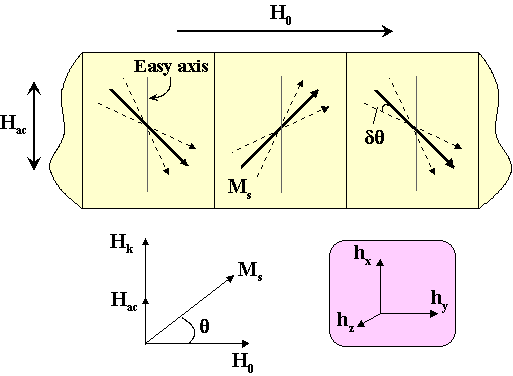
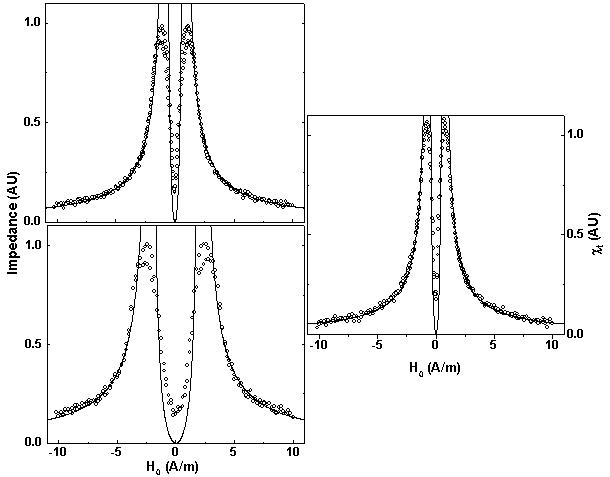
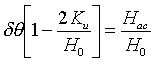
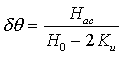
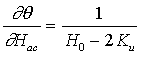
Here a special geometry is chosen consisting of a single domain to illustrate that the transverse susceptibility and therefore the MI response is due to domain rotation. Figure 6.31 shows schematically a simplified domain structure, where an ideal, uniaxial magnetic anisotropy exists, consisting only of anti-parallel domains with 1800 domain walls. There are two components of magnetic field involved: the external dc field H0, which is applied along the length of the film, and the high frequency transverse field Hac which acts perpendicular to the field H0. It is assumed here that there is no domain wall bowing, or domain wall movement on application of the field H0. For simplicity it is assumed that the magnetisation process occurs purely by moment rotation. The longitudinal hysteresis loops (Fig. 6.19)

Simplified domain model

Figure 6.31: Simplified domain model used to illustrate the effective susceptibility for the magneto impedance effect in amorphous thin films. The solid arrows represents the domain magnetisation at equilibrium, and the dotted arrows represent the magnetisation rotated (oscillated) from its equilibrium position due to the field Hac, from its equilibrium position.


Growth and study of magnetostrictive FeSiBC thin films, for device applications, Mannan Ali (1999) 159
(Online Copy)


 Link bar
 Link bar

Email:Mannan.Ali@physics.org Chapter 6: Magneto Impedance investigation
Web: http://members.xoom.com/MannansZone/thesis.html


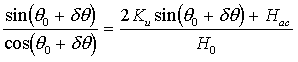
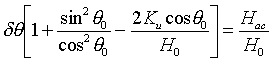
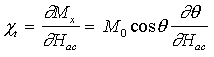
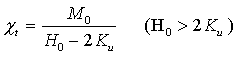
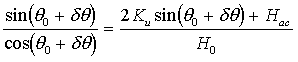
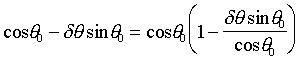
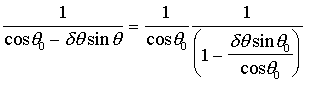
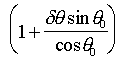
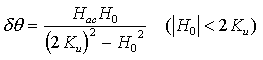
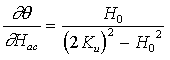
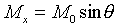
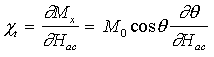
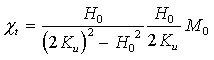
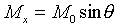
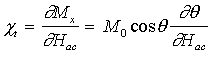
for the samples which possess a uniaxial anisotropy indicate moment rotation, since the MI peaks coincide with the anisotropy field. The MI response is regulated by the transverse susceptibility which can be written as

Eq. (6.5)(6.5)

where the ac transverse magnetisation Mx is simply the oscillation of the component of the magnetisation vector Ms, in the transverse direction (x-axis), due to the field Hac. The average angle q of the magnetisation vector Ms is determined by the balance between the field H0, which tries to align Ms along the z-axis, and the magnetic anisotropy HA, which tries to align Ms along the easy axis. The field Hac causes Ms to oscillate with an amplitude dq about its equilibrium position q, as shown in Figure 6.31. The equilibrium angle q, can be determined by the standard method of minimising the free energy density of the system, from which the transverse susceptibility can be determined. The method used to determine the value of q, is to minimise the total energy for a given field H0 with the field Hac equal to zero, and then to find changes in q for when a small applied field Hac is applied. The energy of this system can be represented by the following free energy density expression

Eq. (6.6)(6.6)

where Eq.is the uniaxial anisotropy density, Eq. is the Zeeman energy due to the field Hac, and Eq. is the Zeeman energy due to the field H0. In order to simplify the treatment, for simplification purposes the demagnetising effect has been neglected; this allows an analytical solution to be obtained. From Figure 6.31, and equation (6.6), the magnetic energy per unit volume of the system is

Eq. (6.7)(6.7)

Minimising equation (6.7) with respect to q we obtain the following expressions for (note m0Ms=1 here)

Eq. (6.8)(6.8)

Eq. (6.9)(6.9)


Growth and study of magnetostrictive FeSiBC thin films, for device applications, Mannan Ali (1999) 160
(Online Copy)


 Link bar
 Link bar

Email:Mannan.Ali@physics.org Chapter 6: Magneto Impedance investigation
Web: http://members.xoom.com/MannansZone/thesis.html


Domain

Figure 6.32: For the uniaxial domain structure considered, the equilibrium angle q, for the magnetisation depends on the balance between the field and the magnetic anisotropy as described by equation 6.12. When H0=2Ku, then q=900.

When Hac=0, the magnetisation will lie at some equilibrium angle q0 for a given field H0

Eq. (6.10)(6.10)

This is only satisfied when

Eq. (6.11)(6.11)

or

Eq. (6.12)(6.12)

where equation (6.11) is the correct solution, since when H0=2Ku, the magnetisation lies parallel to the field H0 (Fig. 6.32).

Now including the term Hac

Eq. (6.13)(6.13)

this will cause the magnetisation to oscillate by an amount dq.

Eq. (6.14)(6.14)


Growth and study of magnetostrictive FeSiBC thin films, for device applications, Mannan Ali (1999) 161
(Online Copy)


 Link bar
 Link bar

Email:Mannan.Ali@physics.org Chapter 6: Magneto Impedance investigation
Web: http://members.xoom.com/MannansZone/thesis.html


Expanding in terms of dq, and after some algebraic manipulation (see Appendix 6.8) the following is obtained

Eq. (6.15)(6.15)

substituting Eq. and equation (6.11) into equation (6.15) gives dq to be
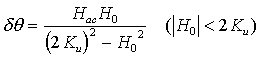
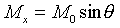
Eq. (6.16)(6.16)

The magnetisation Mx is given by

Eq. (6.17)(6.17)

and the transverse susceptibility is given by equation (6.5) as

Eq. (6.18)(6.18)

Substitution of equation (6.16), leads to the transverse susceptibility due to the ac field Hac for the condition when H0<2Ku.

Eq. (6.19)(6.19)

To take account of the condition where H0>2Ku, i.e. when the moments lie parallel to the field H0, q0=0 is substituted into equation (6.15), and the following expression is obtained for the transverse susceptibility.

Eq. (6.20)(6.20)

Figure 6.33 shows typical MI responses, where the transverse susceptibility as calculated from equations (6.19) & (6.20), have also been plotted. Due to the simplicity of the model the susceptibility diverges as H0 converges on Hk, but it is clear that the MI response is controlled by the magnetisation process of domain rotation through the susceptibility. The non zero value of the MI at the origin from


Growth and study of magnetostrictive FeSiBC thin films, for device applications, Mannan Ali (1999) 162
(Online Copy)


 Link bar
 Link bar

Email:Mannan.Ali@physics.org Chapter 6: Magneto Impedance investigation
Web: http://members.xoom.com/MannansZone/thesis.html


the experimental data indicates the misalignment [Atkison & Squire (1997), Gehring (1998)] of the easy axis (q»900) or there is some domain wall contribution, giving rise to a finite susceptibility at H0=0. The rounding of the peaks is a consequence of a distribution in the anisotropy constants and the easy axis [Atkison & Squire (1997), Gehring (1998)].

Calculated transverse susceptibly

Figure 6.33: Comparison of the calculated transverse susceptibly with MI curves obtained by experiment. The initial value for 2Ku was obtained from the experimental data which was adjusted in conjunction with a scaling constant. Both sets of data were normalised to illustrate that the transverse susceptibly has the same form as the MI response.


Growth and study of magnetostrictive FeSiBC thin films, for device applications, Mannan Ali (1999) 163
(Online Copy)


 Link bar
 Link bar

Email:Mannan.Ali@physics.org Chapter 6: Magneto Impedance investigation
Web: http://members.xoom.com/MannansZone/thesis.html


6.7 Conclusions

Preliminary investigations into the MI effect in magnetostrictive (FeSiBC) and non-magnetostrictive (CoFeB) thin films have shown that MI ratios of 1% are attainable at relatively low frequencies (5-7MHz). It has been demonstrated that the MI response is correlated to the domain structure and the magnetisation process.

For the ribbon samples investigated, it appears that the MI response below 1MHz is due to domain wall movement (oscillations), whereas above 1MHz, as with the deposited films, it is due to the oscillation of the domain magnetisation (domain rotation). This is as one would expect, since these commercially available ribbon based materials are used in low frequency (<1MHz) applications. A simplified rotational model was used to illustrate that the MI curves obtained by experiment were due to the process of domain rotation. Unfortunately the MI measurements carried out on the layered FeSiBC thin films were inconclusive. It seems likely that these preliminary investigations have been impaired by the diffusion of the copper into the magnetic layers and further work is necessary.


Growth and study of magnetostrictive FeSiBC thin films, for device applications, Mannan Ali (1999) 164
(Online Copy)


 Link bar
 Link bar

Email:Mannan.Ali@physics.org Chapter 6: Magneto Impedance investigation
Web: http://members.xoom.com/MannansZone/thesis.html


6.8 Appendix

Derivation of the transverse susceptibility due to domain rotation for the MI effect. See Section 6.6 for details.

The energy of the system

Eq. (1)(1)
Eq. (2)(2)

( m0Ms=1 here)

Eq. (3)(3)

Minimising equation 3 with respect to q

Eq. (4)(4)
Eq. (5)(5)

When Hac=0, Ms will lie at some angle q 0 , for a given field Ho.

Eq. (6)(6)

This is only satisfied when

Eq. (7)(7)

or

Eq. (8)(8)

Now including the Hac term in equation (5)

Eq. (9)(9)

The magnetisation will oscillate by an amount d q.

Eq. (10)(10)

Expanding in terms of d q,

Eq. (11)(11)

Note: Eq.

Eq. (12)(12)

Now


Growth and study of magnetostrictive FeSiBC thin films, for device applications, Mannan Ali (1999) 165
(Online Copy)


 Link bar
 Link bar

Email:Mannan.Ali@physics.org Chapter 6: Magneto Impedance investigation
Web: http://members.xoom.com/MannansZone/thesis.html


Eq. (13)(13)
Eq. (14)(14)

Multiplying top and bottom byEq. and neglecting the Eq. term in equation (14)

Eq. (15)(15)

Now substituting equation (15) into equation (12)

Eq. (16)(16)
Eq. (17)(17)

Neglecting the Eq. term and substituting equation (6) into equation (17)

Eq. (18)(18)
Eq. (19)(19)

substituting Eq.into equation (7)

Eq. (20)(20)
Eq. (21)(21)
Eq. (22)(22)

The magnetisation Mx

Eq. (23)(23)
Eq. (24)(24)

Substituting equation (22) and (7), the transverse susceptibility due to the ac field Hac is


Growth and study of magnetostrictive FeSiBC thin films, for device applications, Mannan Ali (1999) 166
(Online Copy)


 Link bar
 Link bar

Email:Mannan.Ali@physics.org Chapter 6: Magneto Impedance investigation
Web: http://members.xoom.com/MannansZone/thesis.html


Eq. (25)(25)
Eq. (26)(26)

To take account of the condition when the moments lie parallel (H0>2Ku) to the field direction H0, the following conditions Eq.are substituted into equation (19).
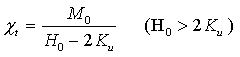
Eq. (27)(27)
Eq. (28)(28)
Eq. (29)(29)

Now

Eq. (30)(30)
Eq. (31)(31)

Substituting equation (29) and cosq=1, into equation (31), gives the transverse susceptibility when H0>2Ku to be

Eq. (32)(32)


Growth and study of magnetostrictive FeSiBC thin films, for device applications, Mannan Ali (1999) 167
(Online Copy)


 Link bar
 Link bar

Email:Mannan.Ali@physics.org Chapter 6: Magneto Impedance investigation
Web: http://members.xoom.com/MannansZone/thesis.html


6.9 References

Ali et al (1999)"Magneto impedance measurements in magnetostrictive FeSiBC thin films", M. Ali, M.R.J. Gibbs, D. Garcia, M. Vazquez, In preparation for JMMM (1999).

Ali et al (1998)"The use of stress for the control of magnetic anisotropy in amorphous FeSiBC thin films: a magneto-optic study", M. Ali, R. Watts, W.J. Karl, M.R.J. Gibbs, J. Magn. Magn. Mater. 190(3) 199 (1998).

Atkinson & Squire (1998)"Phenomenological model for magneto impedance in soft ferromagnets", D. Atkinson, P.T. Squire, J. Appl. Phys. 83 (11) 6569 (1998).

Atkinson & Squire(1997)"Experimental and Phenomenological investigation of the effect of stress on magneto impedance in amorphous alloys", D. Atkinson, P.T. Squire, IEEE Trans. Mag-33 (5) 3364 (1997).

Atkinson et al (1995)"Magneto-Impedance and DE Measurements of iron- and Cobalt-Based Amorphous Wires", D Atkinson, R.S Beach, P T Squire, C.L. Platt, S.N. Hogsdon, IEEE Trans. Mag-31(6) 3892 (1995).

Beach et al (1994)"Giant magnetic-field dependent impedance of amorphous FeCoSiB wire", R.S. Beach, A.E. Berkowitz, Appl. Phys. Lett. 64(26) 3652 (1994).

Costa-Kramer et al(1995)"Influence of magnetostriction on magneto-impedance in amorphous soft ferromagnetic wires", J.L. Costa-Kramer, K.V. Rao, IEEE Trans. Magn. MAG-31(2) 1153 (1995).

Gehring (1998)Discussions with Prof. G.A. Gehring, Sheffield University (1998).

Garcia et al (1998)"Magnetic domains and transverse induced anisotropy in magnetically soft CoFeB amorphous thin films.", D. Garcia, J.L. Munoz, G. Kurlyandskaya, M. Vazquez, M. Ali, M.R.J. Gibbs, IEEE Trans. Magn. MAG-34(4) 1153 (1998).

Garcia et al (1999)"Induced anisotropy, magnetic domain structure and magnetoimpedance effect in CoFeB amorphous thin films", D.Garcia, J.L. Munoz, G. Kurlyandskaya, M. Vazquez, M. Ali, M.R.J. Gibbs, J. Magn. Magn. Mater. (191) 339 (1999).

Mohri et al (1992)"Magneto-inductive effect (MI effect) in amorphous wires", K. Mohri, T. Kohzawa, K. Kawashima, H. Yoshida, L.V. Panina, IEEE Trans. Magn. MAG-28(5) 3150 (1992).

Mohri et al (1995)"Sensitive and quick response micro magnetic sensor utilizing magneto impedance in Co-rich amorphous wires", K. Mohri, L.V. Panina, T. Uchiyama, K. Bushida, M. Noda, IEEE Trans. Magn. MAG-31(2) 1266 (1995).

Morikawa et al (1995)"Thin film magnetic sensor with high sensitivity utilising magneto-impedance effect", T Morikawa, Y Nishibe, H Yamadera, Y Nonomura, M Takeuhci, Y Taga, Tech. Digest of the 13th Sensor Symposium p93 (1995).


Growth and study of magnetostrictive FeSiBC thin films, for device applications, Mannan Ali (1999) 168
(Online Copy)


 Link bar
 Link bar

Email:Mannan.Ali@physics.org Chapter 6: Magneto Impedance investigation
Web: http://members.xoom.com/MannansZone/thesis.html


Morikawa et al (1997)"Giant magneto-impedance effect in layered thin films", T. Morikawa, Y. Nishibe, H. Yamadera, Y. Nonomura, M. Takeuhci, Y. Taga, IEEE Trans. Magn. MAG-33(5) 4367 (1997).

Panina et al (1994)"Giant magneto-impedance and magneto-inductive effects in amorphous alloys", L.V. Panina, K. Mohri, K. Bushida, M. Noda, J. Appl. Phys. 76(10) 6198 (1994).

Panina et al (1995)"Giant magneto-impedance in Co-rich amorphous wires and films", L.V. Panina, K. Mohri, T. Uchiyama, IEEE Trans. Magn. MAG-31(2) 1249 (1995).

Panina et al (1996)"Effect on magnetic structure on giant magneto-impedance in Co-rich amorphous alloys", L.V. Panina, K. Mohri, J. Magn. Magn. Mater. (157/158) 137 (1996).

Rao et al (1994)"Very large magneto-impedance in amorphous soft ferromagnetic wires", K.V. Rao, F.B. Humphrey, J.L. Costa-Kramer, J. Appl. Phys. 76 (10) 6204 (1994).

Sinnecker et al (1998)"Hysteretic giant magneto impedance", J.P. Sinnecker, P. Tiberto, G.V. Kurlyandskaia, E.H.C.P. Sinnecker, M. Vazquez, A. Hernando, J. Appl. Phys. 76 (10) 6204 (1994).

Squire et al (1994)"Amorphous wires and their applications", P.T. Squire, D. Atkinson, M.R.J. Gibbs, S. Atalay, J. Magn. Magn. Mater. (173) 10 (1994).

Squire (1995)"Domain model for the magnetoelastic behaviour of uniaxial ferromagnets", P.T. Squire, J. Magn. Magn. Mater. (140-144) 1829 (1995).

Takemura et al (1996)"Dependence of magnetisation dynamics and magneto-impedance effect in FeSiB amorphous wire on annealing conditions", T. Takemura, H. Tokuda, K. Komatsu, S. Masuda, T. Yamada, K. Kakuno, K. Saito, IEEE Trans. Mag-32 (5) 4947 (1996).

Thomas (1991)"Magnetostriction in transition metal-metalloid metallic glasses A.P. Thomas, Ph.D Thesis, University of Bath, (1991).

Tejedor et al (1996)"Influence of induced anisotropy on magneto-impedance in Co-rich metallic glasses ", M. Tejedor, B. Hernando, M.L. Sanchez, A. Garcia-Arribas, J. Magn. Magn. Mater. (157/158) 141 (1996).

Vazquez et al (1996)"A soft magnetic wire for sensor applications", M. Vazqeuz, A. Hernando, J. Phys. D. Appl. Phys. (19) 939 (1996).

Velazquez et al (1994)"Giant magnetoimpedance in nonmagnetostrictive amorphous wires", J. Velazquez, M. Vazqeuz, D.X. Chen, A. Hernando, Phys. Rev.50 (22) 16737 (1994).

Vac (1993)VAC Vacuumschmelze data sheets (1993).


Growth and study of magnetostrictive FeSiBC thin films, for device applications, Mannan Ali (1999) 169
(Online Copy)


 Link bar
 Link bar